
By Randi Pink
Feiwel & Friends, 2024
Hardcover: $21.99
Genre: Young Adult
Reviewed by Lynn Lamere
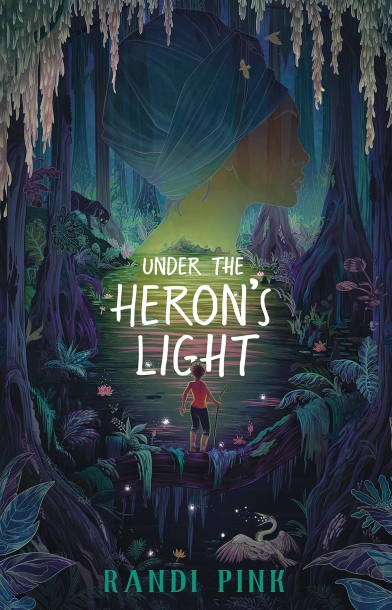 Randi Pink’s Under the Heron’s Light is an entertaining introduction to the relatively new genre of magical realism (not to be confused with fantasy). A quick Google search explains the different fantasy types, such as dark, low, high, speculative, historical, comic, contemporary, and magical. Closest in style to magical realism is low fantasy, or intrusion fantasy, which is defined as a sub-genre where magical events intrude on an otherwise normal world. However, the magical realism Pink uses so effectively offers a realistic worldview while incorporating elements of magic.
These layers of magic are entwined with quite a host of characters. With a dual point of view told centuries apart, readers can relive the life (or lives) of the main character, Baby Lou/Granny Lou. Set on the birthday of Granny Lou and her four grandchildren — Atlas, Pansy, Mika, and Jason — the story begins in present day at the annual “born-day” pig roast to celebrate their shared birthdays. The popular event brings guests from far and wide to Granny Lou’s North Carolina home, which is nestled next to the Great Dismal Swamp. On the eve of the roast, Granny Lou’s tradition is to tell stories all night while the pig roasts, allowing no one else to talk. In one of her many stories, the grandchildren are directed to take “four thousand six hundred forty-two steps to Floriate or paradise.” Being the nineteenth birthday of the four grandchildren, Granny Lou tells her granddaughter, Atlas, that “change coming.” Things are also different during the pig roast storytelling this year —Granny Lou asks Pansy to add to the story, one involving the history of the family, including a murder.
When Granny Lou disappears into the swamp, the four grandchildren and the girlfriends of Mika and Jason, Daphne and Abigail, who were guests at the roast, search for her in an adventure that takes them to the Bray School in Virginia and into the Great Dismal Swamp. Pink’s narrative gets busy at this point, and I found it difficult to follow. Thankfully, she provides a family tree at the beginning of the novel, which is helpful in following the magic in the swamp, where the group encounters the murderer and relatives ready to share their knowledge.
One learns with another Google search that the Great Dismal Swamp still exists and is a big part of African American history. Pink uses the swamp to symbolize the plight of her ancestors in their quest for freedom and justice. The swamp emphasizes the importance of knowing one’s history. It was a part of the Underground Railroad and provided a refuge for many self-emancipated people. Many never left the sanctuary of the swamp, instead choosing to build communities within it.
Pink’s Under the Heron’s Light is an entertaining exploration of the magical realism genre, yet it is also so much more. Pink beautifully uses the novel’s tales to capture the importance of families and history within the magical realism genre. The transition between reality and magic is seamless as she engages the reader with talking animals, resurrected ancestors, and spectacular visuals. With the layers of family history and the legends within the Great Dismal Swamp, the novel gives readers of any age a story of heritage and responsibility.
Lynn Lamere is a composition instructor at Gulf Coast State College. She grew up in Andalusia, Alabama, and now resides in Miramar Beach, Florida.

Leave A Comment
You must be logged in to post a comment.