
January as a House You Walk Through
By Alan Burkett
January 2026
Paper: $14.99
Reviewed by Steve Harrison
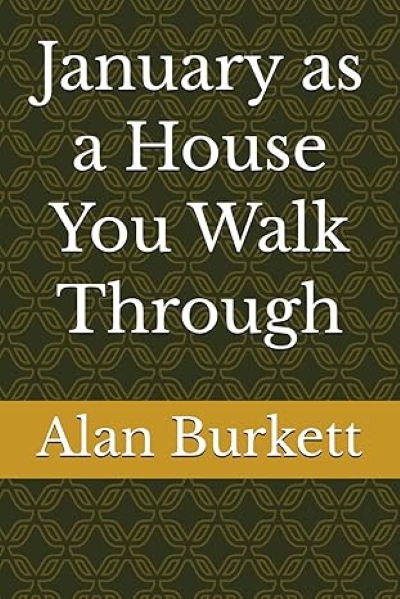
This first book of poems by Alan Burkett has a double structure: the thirty-one poems carry us through the days of January, while the poems also move from the front porch through the living room, kitchen, hall, and bedroom, explore the attic, and ease out the back door into the yard. Four or five poems, most about twenty lines, accompany each stop on the tour. Within these structures, rooms, days, and poems are smoothly connected, moving in a gentle sequence of entrances and exits.
It seems right to read these poems in one sitting. Each poem, each January day, each room is, as Burkett writes, an invitation “to move slowly, to linger where you are, and to trust that staying present is already enough.” The poems iterate the complications we do not require. As the sequence moves through the back door, Burkett advises us “to release what no longer needs holding, and to carry forward what does.” The word “without” appears repeatedly, as though to lighten our burdens: “without audition,” “without apology,” “without insisting,” “without interruption,” “without explanation,” “without interrogation.” The instances are many.
These poems are without rudeness or defiance. They observe and accept the world just as it is. In spirit, they are akin to the works of Zen and Taoist poets. For example, the Zen monk Ryokan wrote, “The sound of the scouring / Of the saucepan blends / With the tree-frogs’ voices.” Similarly, the eighth-century Buddhist poet Wang Wei wrote, “After a long journey at the foot of Mount Sung / I have come home and shut my door.” Like Wang Wei, Burkett brings the experiences of a full life into the calm of a familiar home, and speaks gently to us from there.
As Burkett writes in his brief prologue, these poems offer “a practice of attention, and a quiet faith in the ordinary—the belief that what sustains us most often does so without spectacle.” The titles of individual poems indicate specific instances of such sustenance: “The Light Left On After Midnight,” “The Dog Believes Every Morning Is New,” and “Things I Did Not Know I Was Saving.”
This collection is inventive and charming; it repays multiple readings. And there’s more good news: Burkett’s second collection, The Light Is Still On: Short Poems from a Southern Life, will be out in the coming months.
Steve Harrison grew up in Montgomery, Alabama, attended Auburn University, and worked in the software industry in Seattle, Boston, Raleigh, and Atlanta. Since his retirement, he has lived in Auburn and has taught courses in poetry and world literature. His poems have appeared in numerous journals and reviews, and his book Music for Marching in Place will be out later this year.



Leave A Comment
You must be logged in to post a comment.