
By Karie Fugett
The Dial Press; 2025
Hardcover: $30.00
Genre: Memoir
Reviewed by Edward Journey
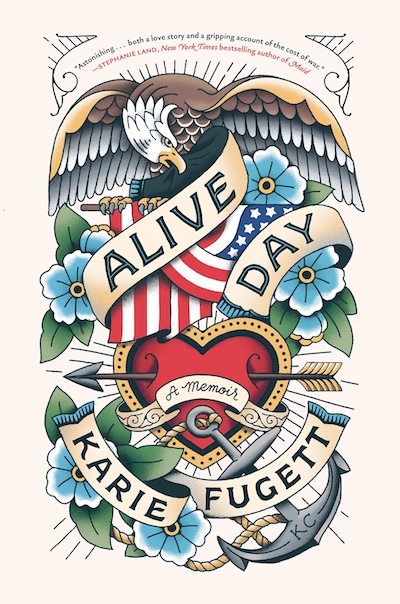
In the military, an “alive day” commemorates the day a soldier almost dies in war but survives. It celebrates a second chance in life. In Karie Fugett’s fearless memoir, Alive Day, she testifies about her relationship and marriage to Cleve Kinsey, a high school sweetheart whose alive day happened in 2006 in Ramadi during the Iraq War. In the process, Fugett chronicles how the “poor, uneducated, young” become pawns in the military; “Cleve and I were chosen,” she writes, “and we played our parts.” In reading Fugett’s story, I found myself thinking, “Will these kids ever get a break?” They sure try.
The military is an integral part of the story, but the damage to this young couple begins well before Cleve’s decision to enlist in the Marines. Karie has a dad in the military, a mother who is often left to raise three daughters on her own, and a transient life of new towns and new schools. Even after her father leaves the military, the family continues to be uprooted, moving to houses they can’t afford and a series of often dead-end jobs. Karie’s rebellious teenage years yield to mad, impulsive rages. Her parents struggle to maintain a respectable middle-class façade despite the father’s symptoms of PTSD: “I learned from my parents that if you had to be poor, you’d better be good at hiding it.” After being part of her family’s dysfunction, Karie vows never to get involved with someone in the military. Cleve’s family is more rooted around Foley, Alabama, but poverty and dysfunction are there, too.
Karie and Cleve lose touch after Karie drops out of high school and sets out on her own to avoid another family relocation. When Cleve reconnects with her on MySpace, Karie is a flight attendant based in Charlotte, and Cleve is a Marine at Camp Lejeune, North Carolina. Later, Karie loses her job after missing a flight and is living in a truck in a Kmart parking lot when Cleve proposes.
Three weeks into his second Iraqi deployment, Cleve’s Humvee is struck by an IED in Ramadi, obliterating his left leg. The heart of Fugett’s story begins at Bethesda Naval Hospital during Cleve’s lengthy recovery with Karie as his caregiver. It is there that Karie’s inherent distaste for military life begins to take a more specific turn as she discovers first-hand the machinations and manipulations of the military’s treatment of its wounded warriors. She observes how the military “relies on young spouses like me as cheap – sometimes free – labor. Military brass knows what to say to make young women think their labor is their duty.” Her concerns about her husband’s possible addiction to painkillers are ignored by military doctors. At one brutal point, she realizes that the Marine Corps is shepherding Cleve’s painkiller addiction to military retirement, so he will no longer be their problem. The young couple faces a long and harrowing haul.
Indeed, Fugett acknowledges that a principal reason for writing her story is to bring attention to the primary and collateral damage inflicted on the soldiers and their families by the system. “The idea of a war hero, to me, was nothing more than a fantasy designed to assuage America’s guilt,” she writes. Such a statement might be attributed to bitterness, but Fugett’s disarming honesty supports her conclusions. Through it all, Karie and Cleve are fortunate to have staunch support from loyal friends – mostly other military couples – throughout their saga. Their humor and affection for each other usually remain intact through the turmoil ahead, even though Karie’s life has taught her that “something bad is always coming.” As Cleve’s military retirement approaches, Karie manages to build and furnish a house for the couple; the house contains Cleve’s “first couch ever” with assistance from the Semper Fi Fund, a fund that assists wounded veterans with needs. Fugett notes how private entities and nonprofits step in to assist in place of a military system that should – a military system that she discovers can’t even get the wording on a grave marker correct.
Fugett takes no prisoners in her narrative, and she presents a raw sketch of the underbelly of military life, but her vulnerability comes through from the opening paragraphs. Her disarming honesty includes revelations about herself and Cleve that a less forthright writer might gloss over or omit. Their fights are as epic as their steadfast commitment. As their codependency grows, Fugett ably packs a lot of dysfunction into one book. Still, a world-weary optimism shines through even in the bleakest moments. Karie and Cleve’s story is not unique; many young couples experience similar challenges, but Fugett’s distinct, clear voice brings depth and freshness to a harrowing, essential story.
Karie and Cleve’s is a powerful story that needs to be shared and attended in a narrative that can be as cathartic for the reader as it no doubt was for the writer. Karie Fugett, a skilled and empathetic natural storyteller, finally gets her break. She goes to college where, with the encouragement of mentors and teachers, including former Alabama Poet Laureate Sue Brannan Walker, she is empowered to tell her story. Alive Day is evidence of that empowerment, paving the way for a new career and brighter future for Karie, her family, and her story.
Edward Journey, a retired university professor and theatre professional living in Birmingham, regularly shares his essays in the online journal “Professional Southerner” (www.professionalsoutherner.com).


Leave A Comment
You must be logged in to post a comment.