
The Other Revival: Poems and Reckonings
By Salaam Green
Pulley Press, 2025
Paper: $18.00
Genre: Poetry
Reviewed by Eliza Jane Franklin
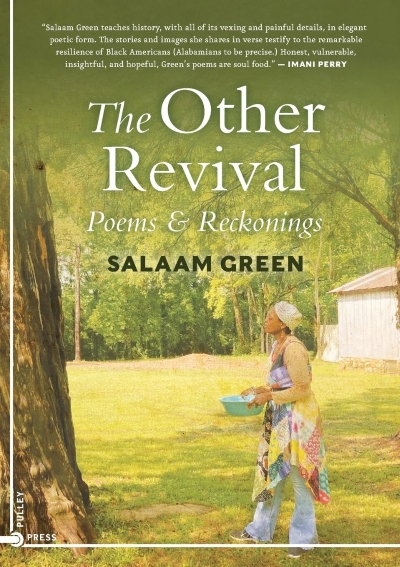
Salaam Green’s The Other Revival: Poems and Reckonings is a literary Ouija board conjuring the past into the present. In this anthology of Southern cultural poems, she shares a thoughtfully composed array of works that speak to both tragedy and triumph. Through the five thematic sections, “Back to the Plantation”, “At the Wallace House Plantation”, “The Woman in the Yellow Apron”, “The Woman in the Yellow Apron Departs for the Tent Revival”, and “Road to the History House”, she provides insight on the plantation, and moreover, the people who inhabited the space. Each page displays her masterful skill as a griot, reconciling histories across generations and racial lines, including spatial and geographical boundaries, to capture the reader’s mind and spirit.
For all those who are heavy laden, this book provides a rest stop for the soul—a revival. Green manifests a gathering under the umbrella of the front and back covers of this book, likened to a traditional Southern Baptist church’s doors swinging open for an altar call. From the onset of the text in “All over Again, I Go”, she provides clarity on her methodology of embarking on a journey to create this book to document healing for a community in Harpersville, AL, that is haunted by the Wallace House Plantation. Her certification as a listener poet through the Good Listening Project is evident in her use of 16 interviews spanning 2 years of collection, from generations of descendants of the Wallace Plantation—Black, white, and mixed race—simultaneously addressing the multi-layered aspects of the site from the antebellum period through present-day.
If a picture is worth 1,000 words, these poems are worth a lifetime. The 39 people enslaved by Samuel Wallace, the original owner of the plantation, are made visible after being rendered undecipherable for numerous years. Many of the poems read like conversations.
In poems like “Wreath Laying a Goodbye,” “Do My Own Eyes,” and “Prelude to a Sweeter Belonging,” memory and grief are vivid. “Selling Babies in Shelby County” is a reminder of the harshness of the slave trade. It is impossible to pick a single standout poem because they are so intertwined.
The unique cadence of each poem entry carefully guides the reader through the various emotional ebbs and flows invoked by these individual testimonies of folks like Peter Datcher, Nelle Gottlieb, and others. There is no way you will finish this book without shedding a few tears. The power of humanity is what resonates most through this masterpiece. It is evident that Birmingham’s First Poet Laureate, Salaam Green, is giftedly connected to the ancestors and is a vessel whose pen makes the unfamiliar known. Few books can be read in and out of order with the message conveyed remaining intact. This is one where that feat has been successfully accomplished. Moreover, the ending of the book leaves you, just as the first page does, wanting to know more about the people of the community of Harpersville and all those connected to the Wallace House Plantation.
Green is clear that reconciliation of the past is possible for those who believe. Her book demonstrates that words have power—enough power to revive lost histories, heal generations of trauma, and, more importantly, liberate those who were silenced.
Eliza Jane Franklin, PhD(c), M.H.C., M.U.R.P., is a historian and heritage conservationist living in Eufaula, AL, specializing in Black memory, material culture, and African American heritage. Known as The Southern Belle Radical, she bridges academic research and public scholarship to recover marginalized histories across the African diaspora.

Leave A Comment
You must be logged in to post a comment.