
By Gin Phillips
Grove Atlantic; 2026
Hardcover: $28.00
Genre: Mystery Fiction
Reviewed by Edward Journey
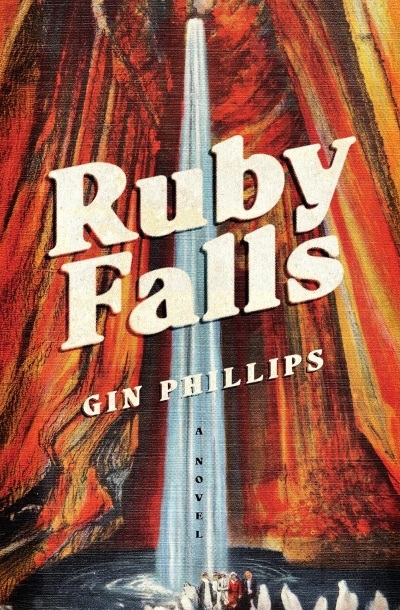
Signs advertising “Ruby Falls” are ubiquitous in the southeastern United States on barns, birdhouses, and billboards, especially as the roads get closer to Chattanooga and Lookout Mountain. The preponderance of Ruby Falls signage rivals that for Rock City, its sister attraction up the mountain. Many have followed the siren call of the barns and visited the cave with its 145-foot underground waterfall – the tallest and deepest waterfall open to the public in the United States. It’s a chilly place to begin with. On my visit to Ruby Falls as a preschooler, a grown-up prodded me to ask the tour guide to turn on the heater; I did and was the victim of good-natured teasing for the rest of the tour.
Gin Phillips, the author of seven novels, including The Well and the Mine and Fierce Kingdom, followed the call and was inspired to turn up the chills in her latest novel, Ruby Falls, a captivating mystery set in Depression-era Tennessee, in the early days of Ruby Falls’ tourist-attraction incarnation. The book is mostly set in the depths of the cavern complex that houses the famous cascade.
Ada Smith, the human focus of the book, is a middle-aged recently widowed woman who discovers the freedom she longs for during her secret solo adventures into the labyrinth of caverns. “… her hair was like a cord of mahogany,” Phillips writes of Ada after her husband’s death, “but it is turning into birch.” A passage in which Ada peels a tomato and reflects on her women ancestors yields some of Phillips’s most lyrical prose. Ada’s fearless cave excursions incite a proto-feminist awakening in the woman. She is awe-struck by the majesty of the place, likening the taming of the caves to “jamming a lion into a cage” and her cave discoveries to “discovering God.” When Ada herself is discovered, alone in the cave, and chastened for her risk-taking, “it seems to her that it should be her choice if she wants to bleed.”
The person who discovers Ada’s spelunking excursions is Quinton, a stoic worker in the caverns. Later, he chooses Ada to accompany him on a mission of damage control when the cave’s owner decides to stage a publicity stunt to boost tourism to the falls during a lagging Depression economy. There is to be an exhibition of a mind reader’s skills: A woman’s hatpin will be hidden somewhere in the caverns, and the mind reader will have twelve hours to locate it. The mind reader is for certain a huckster; nevertheless, “people want to believe.” The exhibition party will include the mind reader and his wife, his manager, a tour guide, a Chattanooga businessman, and a reporter from Chicago. Ada and Quinton will secretly follow the group from a distance in case there is an emergency.
There is an emergency. One of the members of the party is murdered and it becomes Ada’s task to get the group – which now likely includes the murderer – out of the cave and past a waiting press corps before the group’s supplies, including their waning light sources, are depleted. The setting of majestic caves becomes ever more ominous, providing an extra-claustrophobic twist to this take on the “locked room” mystery genre.
The caves are essential to the story. From Phillips’s account of the discovery of Ruby Falls – fictionalized but based on real people and fact – through Ada’s spiritual awakening and the role of the caves in thwarting the rescue of the desperate party, the caverns and its spectacular waterfall are ever-present as both pathway and obstacle. From extraordinary circumstances, Gin Phillips has crafted a credible whodunnit highlighted by strong character development and backstories, a memorable setting, and an occasional well-placed MacGuffin.
Edward Journey, a retired university professor and theatre professional living in Birmingham, regularly shares his essays in the online journal “Professional Southerner” (www.professionalsoutherner.com).


Leave A Comment
You must be logged in to post a comment.