
The Story of Quilts of Yvonne Wells
By Stacy I. Morgan and Yvonne Thomas Wells
Foreword by Gail C. Andrews
University of Alabama Press, 2024
Paperback: $60.00
Genre: Art, Biography
Reviewed by Van Ricaurte
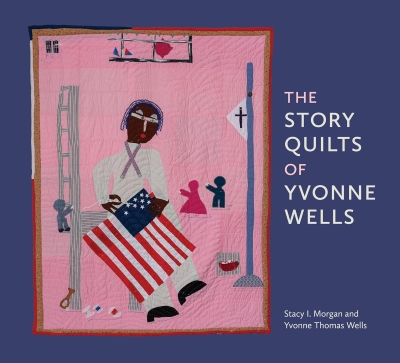
The Story of Quilts of Yvonne Wells explores the artistic influence of African American Tuscaloosa folk artist Yvonne Thomas Wells and her journey into the art of quilt-making, with images and descriptions of the meanings within over 100 quilts. Stacy I. Morgan draws upon interviews with Wells, her family, longtime friend and agent Robert Cargo, and numerous art reviews of her quilts, while ensuring Wells’ own voice remains central. Morgan only adds to Wells’ art by layering contextualization of the historical, political, and cultural importance of Wells and her quilts.
Morgan divides the book into chapters that blend Wells’ narratives with the impact of her art and images of the quilts being discussed. The chapters are then divided into galleries of quilt photographs, each accompanied by Wells’ own descriptions. The chapters include Wells’ quilt-making origins as an artist, who began not from a generational quilting tradition, but as a high school teacher’s practical hobby that turned into a creative outlet. After ultimately being persuaded to share her quilts with the public at the 1985 Kentuck Festival of the Arts, Wells stepped onto a larger stage as a renowned artist, with her quilts sold and exhibited in galleries and museums across the globe. We learn that Wells’ quilts are distinctive in that each tells a pictorial story through layered tactile materials, color themes, and prints.
Morgan conveys how this tactile emphasis makes the quilts so compelling. What Wells feels and sees in the various fabrics is of utmost importance to her so that a viewer of her quilts can understand what they see, even with no personal experience: “That could be me. They can see a color or material that identifies with blood, tears, or mud, or fire…you can read it and you can almost put yourself where they are…” Whether she is working with burlap, lace, prison pants, or a print she chased down from a student’s shirt, each material is placed with a specific purpose and meaning.
When Wells combines the material nature of her quilts with her ability to share her feelings and emotions, what occurs is remarkable. Morgan outlines an impactful example, the 1993 quilt Wells created for the NAMES Project AIDS Memorial Quilt to express the loss her community faced due to the AIDS crisis. To note a few of the many symbols contained in the quilt – paired blue hearts represent two men, while a paired white and blue heart represents a man and a woman, to depict one way the illness spread. Red stars represent the people who died, with a sun set against bright fabric that gradually darkens until it sets, and it is dark, representing a death, along with a graveyard at the bottom. Creating this quilt did not go against her own deeply held Christian beliefs, even though her compassion would not have been a common sentiment at the time. She wanted people to see her quilt and think, “…This could be my child suffering from AIDS. This could be me showing that final gesture of love for my child as I drive to their funeral.”
Wells is just as unflinching in her depictions of the horrors of slavery and the tragic and triumphant events of the Civil Rights era, especially in Alabama. Her quilts do not dampen the violence and tragedies that occurred; Wells depicts the past honestly, forcing her viewers to do the same. Morgan notes a persistent sociopolitical commentary in Wells quilts, often linking the past with the present in quilts like The Trial of the Amistad Captives and The Scottsboro Boys series, which speak to the past and current inequities of the U.S. justice system for people of color.
Morgan effectively shows an artist driven by an imaginative interior world, one which contains creativity, vision, astounding compassion, insight into human nature and the American and Southern racial and political landscape, and a wish to share that interior place with the world as a storyteller through her quilts. Morgan has made a captivating read where we learn that Wells’ stories of her quilts are just as valuable as the quilts themselves, making The Story of Quilts of Yvonne Wells not just a striking visual archive of Wells’ quilts, but a demonstration to how a quilt can carry the depth of personal and collective history, as seen and deeply felt by the artist Yvonne Wells.
Van Ricaurte is of American Latina heritage, raised in Blount County, and a UAB graduate in Anthropology. She conducted more than 200 oral histories with seniors for UWA’s Black Belt Oral History Project from 2012 to 2014. She now works in the legal field in Birmingham and volunteers with the Crisis Center’s Senior Talk Line.

Leave A Comment
You must be logged in to post a comment.