
No Place for Pilgrims: Solving the Murder of William Moore, the Last Cold Civil Rights Case
NewSouth Books, 2025
Hardcover: $34.95
Reviewed by Lesa Carnes Shaul
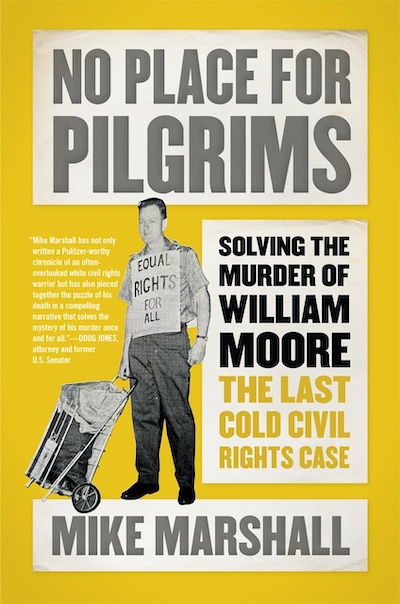
Sometimes, when we are young and idealistic and full of dreams and promise, we imagine ourselves becoming the kind of adult who will make a difference, who will leave a mark, who will change the world. Then we move inexorably through time, and life and the general everydayness of existence intervene. We get tired. We get old. We assume that a younger generation, just as full of dreams and goals as we once were, will take up the mantle of righteousness we shrugged off under the burden of careers, mortgages, family obligations, disillusionment. When Mike Marshall was fourteen, he embarked on what initially seemed like the fulfillment of a common school assignment: a research project on civil rights for his ninth-grade civics class. We know these projects; we’ve all done something of the sort at some point in our academic journeys. The bicentennial year of 1976 was ripe for national reflection and retrospective examination, and young Marshall found an article in Time magazine about a man named Wiliam Lewis Moore, a white Civil Rights advocate from Binghamton, New York, who, on a one-man protest march from Chattanooga, Tennessee, to Jackson, Mississippi, was gunned down in the small community of Keener, Alabama. The killer (or killers) escaped punishment.
Marshall says in the introduction to No Place for Pilgrims: Solving the Murder of William Moore, the Last Cold Civil Rights Case, “I made a promise after reading the article: I would solve the murder when I was old enough to handle a murder investigation.” Over twenty years later, as his mother was dying of cancer, Marshall renewed his pledge to find out the truth about what happened on that lonely stretch of highway outside Keener in April of 1963. Marshall frankly admits that his mother was “unimpressed”; instead, she cautioned him against “stirring up trouble.” Half a century after Marshall first learned about William Moore’s murder, we have the fulfillment of both promises.
The title of the book comes from the same Time article that hooked Marshall: “The Sand Mountain area between Chattanooga, Tenn., and Gadsden, Ala., is no place for pilgrims. It is a land of mountaineers who tote rifles in their cars, glare in suspicion at strangers, and believe unshakably in racial segregation.” An exceptional storyteller and former longtime journalist, Marshall deftly weaves personal narrative with historical record. In the introduction (“A Walnut Tree Dies in Keener”), we meet not only William Moore and get an overview of his murder but also an adolescent Mike Marshall, who is both puzzled and fascinated by the Time article about Moore—puzzled, because he has close family members who live on Sand Mountain (“I had never seen residents of Sand Mountain carry rifles in their cars or watched them glare in suspicion at strangers”) and fascinated, because when we are young, we are only beginning to figure out how the people we love and call our own can be connected to infamy. In Part I (“The Walk”), Marshall retreats from the narrative to tell the story of William Lewis Moore, “New York born and Mississippi bred, a medley of cultures and convictions,” from his childhood until the night he was fatally shot in Etowah County, Alabama. Described as a “drifter and a dreamer,” Moore seems like a modern-day Henry David Thoreau, seeking a way to be a counter-friction against the machine of oppression in his time. But Thoreau spent one night in jail for not paying a poll tax, and he lived to write about his symbolic gesture of passive resistance. Moore paid with his life for aligning himself with Civil Rights defenders in the 1960s South.
In Part II (“The Demands of a Deeply Offended Community and State”), Marshall shifts from the national reaction to Moore’s murder to the area in which the crime took place. To quote Margaret Atwood, “Context is all,” and Marshall unwraps the layers of historical and cultural circumstances that encased a grenade of a city on the verge of explosion. At the time of Moore’s murder, Gadsden, Alabama, the nearest municipality to the community of Keener, was a city besieged by economic woes, government corruption, labor conflicts, and racial turmoil. Wearing a sign that read, “Equal Rights ForAll” and pushing a cart that bore a poster the locals mistook for Communist propaganda, Moore sojourned into a region primed for violence. Despite an international flurry of news stories and even protest appearances in Etowah County by Marlon Brando and Paul Newman, the investigation was confounded at every level—from local law enforcement to Hoover’s FBI. As Marshall flatly concludes Part II, by September of 1963, “[t]he investigation was dead.”
Marshall reenters the narrative in Part III (“The Search”) when he returns in 2000 to Sand Mountain, the place he knew and loved so well as a child. Armed with the skills that made him a highly successful journalist, Marshall knocks on doors, visits public libraries, wears the leather off his shoes, and puts innumerable miles on his car in his efforts to crack the last cold Civil Rights case. His investigation proves what Faulkner once said: “The past isn’t dead; it isn’t even past.” Many of the principal actors and suspects have died, and those still alive aren’t always eager to talk. Yet Marshall persists, and that is what makes the second half of the book especially powerful. Through Marshall’s riveting prose and exhaustive research, we walk with William Moore and those who sought to find or thwart justice for his murder in the first half of No Place for Pilgrims. In the second half, we are reminded of what real investigative reporting looks like and of the perseverance and bravery required to expose the truth. In the final section, Part IV (“Understanding”), Marshall intimates that perhaps thetruth isn’t always revealed in a flash, an epiphany, like we get in stories and movies, but rather a slow dawning and the bittersweet satisfaction of a quest fulfilled.
In “The Road Not Taken,” Robert Frost writes of contemplating two paths in life, choosing one “because it was grassy and wanted wear,” but wistfully admitting, “Oh, I kept the first for another day! / Yet knowing how way leads on to way, / I doubted if I should ever come back.” This poem is often mistakenly interpreted (and incorporated into countless commencement speeches) as a celebration of the seemingly limitless choices that lie before the young. But that’s not what the poem means. It’s about the justifications we create to stave off ambivalence about our life choices—or worse, regret at not having taken that other road. Mike Marshall made good on his promises, both to himself and his dying mother, and he has nothing to regret about following both William Moore’s noble path and his own search for answers.
Lesa Carnes Shaul spent the first eighteen years of her life in a small town atop Sand Mountain in northeastern Alabama. She is a professor of English at the University of West Alabama and the author of Midnight Cry: A Shooting on Sand Mountain.




Leave A Comment
You must be logged in to post a comment.