
St. Martin’s Press, 2026
Hardcover: $29.00
Genre: Thriller
Reviewed by Dr. Candice N. Hale
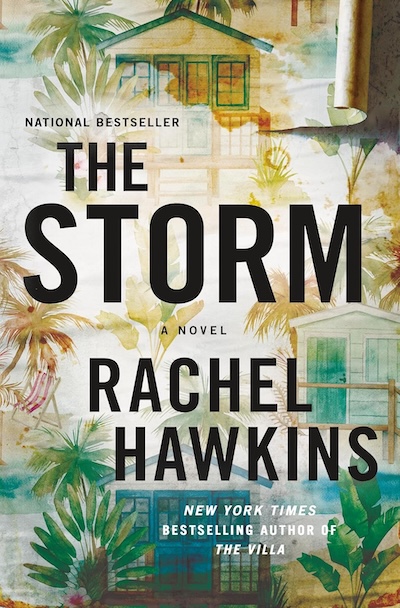 After enjoying flawed characters, surprising twists, and dark suspense in The Woman Upstairs, The Villa, and The Heiress, I expect Rachel Hawkins’ newest thriller, The Storm, to bring the same excitement. Although The Storm at first seems quieter and more restrained, I soon saw that Hawkins is not trying to shock us right away; instead, she slowly builds tension between the characters. So, the novel’s strength is in its people—their choices, their loyalties, and how they blame or protect each other in the peaceful town of St. Medard’s Bay, Alabama. At first, I was caught up in the obvious hurricane and the doomed love affair. But the essence of The Storm is in the complicated relationships between Geneva, Lo, Delphine, and Audrey. There is more than one storm here, and as readers, we must decide which one we are following, since it changes how we see the story. The storms I found most interesting were the emotional battles inside these women—their secrets—how are they linked? Even better, how do these women escape these situations? Ultimately, The Storm reminds us that facing our own conflict is the only way to discover truth and achieve freedom.
Beneath the lurid entanglements, bad weather, and personal storms in the novel, the biggest threat is the townspeople assigning blame for what happened to Governor Fitzroy’s son. The book makes it clear that blame is more powerful than truth, and it spreads faster than the wind over the bay. In 1984, a reporter observed about the case, “If you ask me, this was about Governor Fitzroy wanting someone to blame for the loss of his son. And I think the jury sensed that—which is why Miss Bailey is currently a free woman, and why, frankly, I suspect she’ll remain one.” That line sets the tone for how the town discusses Lo Bailey—a beautiful nineteen-year-old who can become a target for overwhelming grief and anger. Hawkins uses gender dynamics to explore how narratives shift to cater to the First Family in St. Medard’s Bay. These were enough to intrigue writer and journalist August Fletcher, who emailed Lo Bailey. Fletcher sees the compelling nature of her case and wonders why the town tried to bury a scandal-murder-betrayal for appearances’ sake. Fletcher jokes in his email to Bailey: “I mean, if things had turned out differently, who’s to say you wouldn’t have been our First Lady at some point? Instead, you were vilified and slandered, a 20th-century Hester Prynne in a Duran Duran T-shirt.” Amid the chaos of blame, sexism, and lies, Hawkins plants a seed for readers: what happens when the truth is buried? Why is blame allowed to settle on the shore instead of truth?
Apart from the mystery in The Storm, the tangled, webbed connections between the women drew me in, pushing me to explore their stories more deeply. It’s clear that Geneva, Lo, Edie/Frieda, and Ellen, unfortunately, have moved recklessly to cross paths with wrongdoers; yet they maintain a solid mix of love, loyalty, and doubt toward each other. These women show up when needed and make things happen. In fact, they stand strong against the steely gaze of St. Medard’s Bay townsfolk, shaped by a shared history of gossip and unyielding pressure. Their relationships are just as weathered, worn, and genuine as the storms pounding the coast. As someone from a small town in Alabama, I understand how that pressure can rise high like a tide, ready to sweep you under with judgment and lies.
While hurricanes might seem like background noise to readers, they actually reflect the internal storms each woman endures in the novel. In one way or another, the women face secrets, unplanned pregnancies, infidelity, betrayal, exhaustion, and shame that influence their experiences as teenagers and adults. Over time, these storms peel back the layers of those experiences and wounds. Yet Hawkins reminds us that not all damage is visible, and harm can exist without a bruise. It is Lo’s mother, Beth Ann Bailey, who confesses to a lifeless, harsh marriage: “He never hit me, never forced me in the marriage bed, but there are other ways for a man to be cruel.” Beth Anne’s quiet suffering is a clear road map for understanding Lo’s validation and approval from Landon Fitzroy. Landon uses Lo as his side project and temporary amusement. In essence, the outward storms mirror the ongoing cycle inside—what appears to be love often turns into another form of erasure—and the women must choose whether to keep the secret or to name it and break free.
The silent strength isn’t just woven into the women of this story, but it also exists in the spaces they inhabit. The Rosalie Inn functions as a place of escape and refuge in the novel, representing another woman who is weathering the storm alongside a complex group of friends. Like these women, the inn holds onto years of secrets and memories while embodying the burden of wreckage and ruin. This need for extra care often places Ellen, Edie/Frieda, Lo, and Geneva in difficult positions, yet they persevere. The women recognize that the mix of love and weariness required to maintain the Rosalie is profound: “Sometimes even places we love can become weights around our necks.” In essence, the Rosalie Inn serves as both a symbol and a place of recovery and healing. Storm recovery is never simple or linear—it takes support and community effort to rebuild what was lost. Hawkins tells us that storms leave behind a new kind of math: what you can carry, what you can replace, and what you can’t. Like the women of St. Medard’s Bay, the Rosalie Inn has weathered more than one storm. It knows how to endure damage without collapsing, how to keep standing even as something inside splinters.
I initially misjudged the book because I was waiting for the boom. After sitting with the book longer, I realized that the satisfying crescendo comes from the characters themselves—it’s the way their inner turmoil rises and falls like the storms around them. As a woman in Alabama, afraid of storms, I understood the anxiety that builds before they arrive and the relief that follows after they pass. There’s also the fear of calling family and loved ones and counting blessings to survive yet another storm. But, in this novel, it’s more than just enduring storms—it’s about choosing who to bring into the next season, who to share your stories with, and who helps to build afterwards. The Storm shows us that we can keep the parts of our lives that can withstand the wind.
Candice is a part-time book influencer on IG, freelance writer and reviewer, and professor of composition and literature at Auburn University. In August 2023, she contributed to the edited collection Jesmyn Ward: New Critical Essays by Edinburgh University Press.


Leave A Comment
You must be logged in to post a comment.