
The Old Breed… The Complete Story Revealed
Knox Press; 2025
Hardcover: $35.00
Genre: World War II History, Memoir
Reviewed by Edward Journey
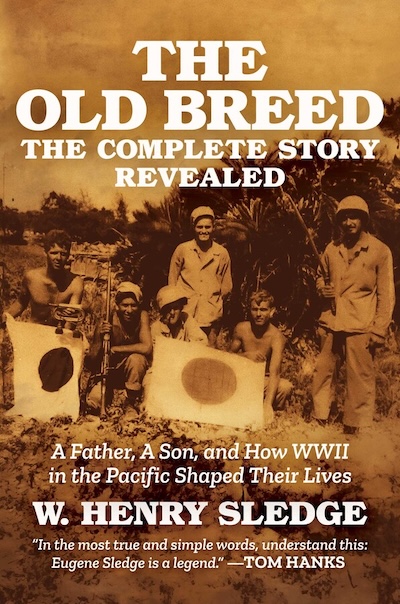 Eugene Sledge’s With the Old Breed: At Peleliu and Okinawa (1981) has been called “one of the finest memoirs to emerge from any war” and has been compared to The Red Badge of Courage and All Quiet on the Western Front. Sledge, a Mobile native, worked on the book as a young professor at Alabama College (now the University of Montevallo). According to W. Henry Sledge, his youngest son, Eugene “seemed driven to get it all down on paper, as if doing so would purge the demons that caused his nightmares.” With the Old Breed was a touchstone for Ken Burns’s World War II documentary, The War, and the 2010 HBO miniseries The Pacific. Eugene Sledge compiled the memoir from notes he kept in a pocket-sized Bible during his wartime service in “K/3/5” – K Company, 3rd Battalion, 5th Marines.
That youngest son, Henry – who has become a World War II historian in his own right – has taken his father’s words and composed a new book conceived in legacy and completion. The Old Breed… The Complete Story Revealed is subtitled “A Father, A Son, and How WWII in the Pacific Shaped Their Lives.” The new book compiles unpublished material from the original With the Old Breed manuscript with Henry Sledge’s memories of the time while his father was writing the book and the events that came after, including his own visits to the Pacific locations where his father served amidst the “filth, shock, blood, and maggots” of the Pacific theatre. In doing so, he further illuminates the man whose memories of the conflict were presented through the eyes of “the central observer, not the central character.”
With the Old Breed was praised for its realistic depiction of the horrors of warfare. Much of that uncompromising tone is found throughout the manuscript excerpts Henry Sledge includes in his book. As the first shots are fired at Peleliu, Eugene remembers thinking that “none of us will ever get out … alive.” Some revelations are difficult to imagine; prior to landing in Okinawa, officers brief the soldiers that the casualties are expected to be between 80 and 85 percent. How could they go on with such odds? They did, and the Okinawa landing on April 1, 1945 – Easter Sunday and April Fool’s Day – elicits comments “both profane and profound.” Once on Okinawa, “our nostrils would be saturated with the smell of death for seven full weeks” if they lived that long. Watching a kamikaze raid, Eugene realizes that even though the Japanese soldiers’ devotion to their cause was fanatical, “it was incredible bravery.”
Eugene Sledge writes of American soldiers having mental breakdowns in combat, of replacement troops killed by enemy fire within five minutes of joining K Company, and of seasoned troops getting killed days before the end of deployment. He writes of fishing with dynamite, of the brutal scavenging of souvenirs from the dead Japanese, including “digging out” the gold teeth of corpses. He writes about the shared grief of soldiers over the death of a beloved dog back home and of a soldier casually killing an injured Okinawan woman as Eugene was going to find help.
Eugene Sledge does not emphasize his own valor and integrity, but those qualities come through. An especially moving scene involves his encounters with Japanese civilians on Okinawa. An old man bows obsequiously to Eugene as he passes and, when Eugene bows back, the man is astonished and walks away “grinning like he wasn’t afraid anymore.” From then on, Eugene returns the bows of the Okinawans – “It was the only way I could assure these pitiful people we weren’t going to harm them, and they seemed to understand.” At times the scenes of brutal battle, the names of places, and the inventory of weapons that are essential to a tale of war become overwhelming. Still, it is in the most personal moments – the homesickness, the kindness to civilians, the tales of friendships formed and friends lost, the flash of jealousy of other soldiers who have had the luxury of a shave and a bath – that the poignancy and truth of Eugene’s story come through vividly.
Henry Sledge, who was raised in a house full of mementos of the war, was a son who asked questions, listened, and remembered. His personal narrative throughout the book gives perspective on how the war impacted his father for the rest of his life. He takes pride in his father’s wartime “semblance of decency amid the horror of it all.” Henry traveled to Peleliu in 1999 for the fifty-fifth anniversary of the battle, followed his father’s footsteps, and was able to share his experiences with his father in Eugene’s last years. Evidence of the changes that the war brought on the man is scattered throughout Henry’s comments. One telling comment, early in the book, sums up Eugene’s post-war attitude toward hunting. He was an occasional hunter before going to war. After the war, he said, “When I survived the former, I gave up the latter.”
Eugene’s memories of wartime stoicism occasionally take on an almost humorous aspect. Decades after the war, when his son complains about breakfast toast, Eugene tells him about regularly finding weevils in the bread in Pavuvu and finally thinking of it as an “extra source of protein”; remembering the deprivations of the wartime Pacific, Eugene would respond to petty complaints with “I’m just happy to have dry socks.”
“When the war ended,” Henry writes, “[Eugene] made his peace, came home, and got on with his life as best he could.” In With the Old Breed, he tried to chase the nightmares away and memorialized his buddies who didn’t get to have a life after the war. Henry realizes that “his war never completely ended.” With The Old Breed… The Complete Story Revealed, Henry has written a story of legacy, but it is also a story of love.
Edward Journey, a retired university professor and theatre professional living in Birmingham, regularly shares his essays in the online journal “Professional Southerner” (www.professionalsoutherner.com).

Leave A Comment
You must be logged in to post a comment.