
By Gary S. Minder
RubyeGay Publishing, 2025
Paperback: $14.95
Genre: Historical Fiction, Young Adult Fiction
Reviewed by Carrie Dalby
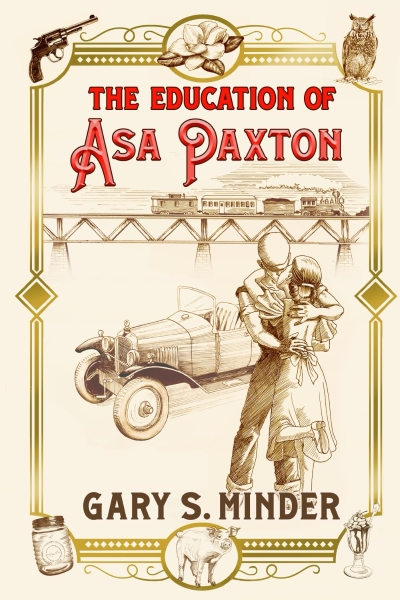 “Don’t judge a book by its cover” is good advice to remember when it comes to The Education of Asa Paxton. What looks like a sweet coming-of-age historical novel is laced with enough Southern Gothic atmosphere to make William Faulkner proud. While the story starts off in 1932 Chicago with a twelve-year-old Asa Paxton and his family, we are soon headed to the Deep South as Asa’s father agrees to take a railroad job in Blue Rock, Alabama. A section detailing Uncle Clem’s backstory compromises chapters three through six and takes us back to 1922 Mississippi. This extended flashback tells a multi-generational story that’s more reminiscent of a family saga than a straight coming-of-age tale. Those who enjoy multi-generational novels will appreciate the insight.
A warning note found in the Acknowledgments states that the story includes “tobacco and alcohol use and language” as well as “Racism, rape, and incest,” but other potentially problematic content is not listed. Describing the book as “Southern Gothic” could solve the setback of laundry listing potential triggers that often lead to spoilers. Minder’s story showcases social division, tragedy, marginalized characters, skewed religion, sinister events, and debauchery—all hallmarks of the genre. Knowing that the story takes place in the Jim Crow era Southeast covers the other offensive issues woven throughout the pages.
The nostalgic mood of Asa’s tale, which primarily takes place in northern Alabama during the 1930s, marks it for a mature audience looking back at their own youth. That tone is made more apparent as the story darkens, and older Asa’s thoughts become more numerous in the narrative. Asa’s first-person voice is rich and reliable as we skim his years from twelve to eighteen, but that means we don’t see much character growth. Asa and his family are consistent throughout. Mr. and Mrs. Paxton remain calm, cool, and collected—even as the mother grew scared at events or upset over language a few times—almost too perfectly. That works for the older narrator’s voice and readers looking back, but those in the throes of young adulthood might find it unrealistic.
Humor goes a long way in balancing the experience of a heavier read, and Gary S. Minder strikes a harmonious chord with the sprinkling of jokes amid the serious social issues. With Shanks, Itchy, and the cast of locals, readers get an earful of Southern dialect and mannerisms that can hold charm or venom depending on the speaker. Descriptions of the locations make it easy to visualize and walk alongside Asa in the railyard, school, or town. And when Asa experiences his first kiss (and more), we’re right there for the awkwardness and exhilaration.
The Education of Asa Paxton is a novel that fans of historical Southern Gothic will want to take note of, especially if there is more to what’s listed as The Haint Blue series. After finishing this first book, I’m not sure which dirt road or train track out of Blue Rock, Alabama, the series could take—and that’s exciting.
Carrie Dalby is the author of seventeen novels, one novella, and numerous short stories primarily in the realm of historical Southern Gothic. She lives with her family in Mobile, Alabama, where she balances caregiving responsibilities with writing and her special interests (currently local history and the Mobile Police Department).




Leave A Comment
You must be logged in to post a comment.