
By Amos Jasper Wright IV
Livingston Press, The University of West Alabama; 2026
Paperback: $22.00
Genre: Novel
Reviewed by Edward Journey
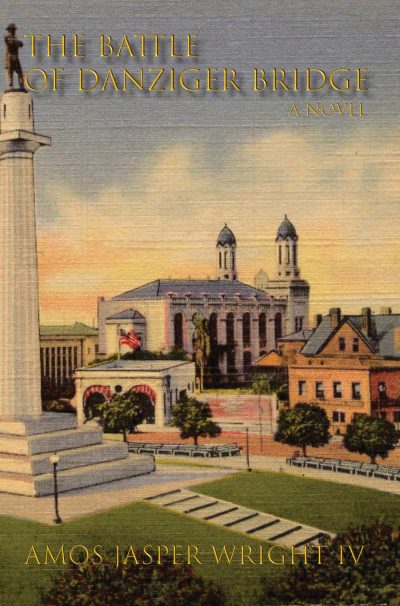
Six days after Hurricane Katrina and its aftermath ravaged New Orleans, New Orleans police officers, responding to a false or fabricated “officer down” call, murdered two innocent, unarmed victims and shot four more on Danziger Bridge over the Industrial Canal. Those murdered were hurricane survivors crossing the bridge in search of food on the other side; they survived the storm but couldn’t survive NOPD. The new novel by Amos Jasper Wright IV (Nobody Knows How It Got This Good, Petrochemical Nocturne) takes its name from that atrocity. Wright’s The Battle of Danziger Bridge is a verbal storm surge focused on two of the city’s defining events – Hurricane Katrina and the removal of Robert E. Lee’s statue from his eponymous traffic circle – and the impact of the 2016 Presidential election. Speaking of the election, one character asserts that 2016 is “a year we may try to forget but which will never forget us.”
In a 2023 interview with Bradley Sides for Alabama Writers’ Cooperative, Amos Jasper Wright IV says, “As you probably noticed, I tend toward the verbose … Being succinct does not come naturally to me.” That’s an understatement. Wright’s is an impressive logorrhea, with daunting wordplay and nonstop verbal gymnastics; not for naught is it called “creative writing.” His book is published by the University of West Alabama’s Livingston Press, an imprint whose books are often, in turn, clever, perplexing, and exhilarating. The Battle of Danziger Bridge is often all three simultaneously. The audacity of the book’s first hundred or so pages made me somewhat resistant; by that point, though, I got lost in the gonzo rhythm and the remaining three hundred pages were hard to put down. At the end, I was exhausted but wanted more (maybe). It is a robust fever dream, an astounding and hallucinatory accomplishment.
By my count, the novel’s fourteen long sequences are voiced by eleven often nameless characters. The first two are told by “Man on Patio” who is moved to build an Apocalypse Patio onto his termite-infested Lower Garden District house from which to observe the opening of the seven seals triggered by the 2016 election of “President Cheeto.” Man on Patio – let’s call him MoP, relishes any opportunity to goad his next-door neighbor, Blanchard, one of the “entropic bigoted bedlamites” who voted for Cheeto. MoP realizes that American society has “reached peak woke and peak bigot at the same time.” MoP’s’s wife, Heloise, admits that “Sometimes I watch Fox & Friends so you don’t have to.” When her husband inevitably chooses a slasher film on movie night, Heloise inevitably identifies with the movie’s “Final Girl”; there is always the “Final Girl” on the slasher agenda. Heloise is the voice of three sequences and the keeper of her mother’s King Cake recipe, which is never written down and never to be shared. She fears legendary New Orleans murderer Axeman and, knowing that he spares any house that plays exuberant jazz in their parlor, she fervently plays the same jazz ditty well into the unsettled night. She occasionally lurks around her house wielding her King Cake knife and ruefully contemplates her 3D-printed handgun.
Blanchard, the nemesis of MoP and Heloise, gets his chance to be heard. Disgusted with that NFL “take a knee crap” during the playing of the national anthem, Blanchard only watches reruns of old football games, especially the 1972 Sugar Bowl between cheating Oklahoma and scoreless Penn State. He feels that active shooters “are a great tradition in this country, like baseball or barbecuing” and uses bullet casings as his Mardi Gras throws from a Comus float. The Blanchard family haunted his Lower Garden District house “long before they were even dead.” Post-Katrina, Blanchard is part of a cadre of businessmen scheming to flip New Orleans from “a Democratic stronghold into a Republican wet dream” – words that ring as true in 2026 as they did in 2005. In short, Blanchard tells the present to “get off my lawn.”
Other diverse voices tell stories of New Orleans in the 21st Century. A Katrina survivor provides a relentless eighteen-page paragraph on death, destruction, and decay. A patient describes the nightmare of riding the storm out at Charity Hospital without power. A Saints fan teaches me more about the Saints than I learned in decades of following the team (“We were the Browns before the Browns were the Browns”). An Uber driver / tour guide / erstwhile handyman gives Heloise a lift. An acquaintance of Blanchard from the Krewe of Comus rides on a float of resurrection. A mortician camps out on Lee Circle’s neutral ground to observe the before and after of the statue’s removal. The owner of one of Brad Pitt’s leaky “Make It Right” houses in the Lower Ninth Ward discovers “healing through arts and crafts” as he caustically takes on “Pitt’s disaster porn” and the “starchitect” designers who designed it. Finally, a Danziger Bridge survivor provides his harrowing eyewitness account of the slaughter of innocents on the bridge.
Amos Jasper Wright IV provides meticulous detail and a keen grasp of local history to support his interconnected stories of a specific time in the lives of a unique American city. Reading it, there are times when the stories seem to be a condemnation of the place. At other times, it feels like a quirky celebration. At all times, it provides a complex portrait of a complicated and flawed place in which misery and joie de vivre coexist. It is a scathing and frequently hilarious exposé of the American character. As one of the characters opines, “In fifty years people will look back on today and want to know what the f__k was going on.”
Edward Journey, a retired university professor and theatre professional living in Birmingham, regularly shares his essays in the online journal “Professional Southerner” (www.professionalsoutherner.com).


Leave A Comment
You must be logged in to post a comment.