
Gallery/Scout Press; 2026
Hardcover: $30.00
Genre: Historical Fiction
Reviewed by Dr. Candice N. Hale
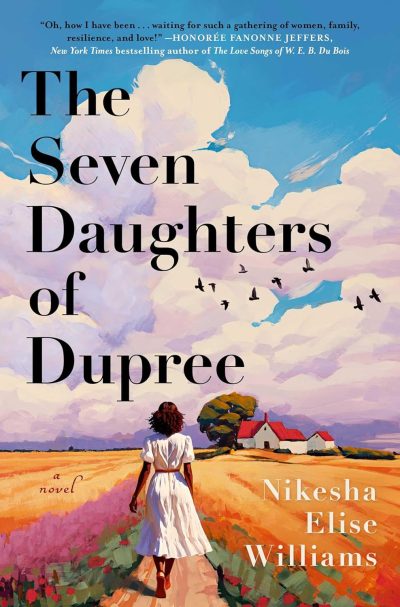 Alabama maintains a steady grip on training its daughters to be guardians of family history, hard truths, and stories the family never wrote down but passed down through memory. Although an author may fictionalize a southern town, its values and beliefs often feel familiar to readers. This is exactly what Nikesha Elise Williams does in her new historical fiction novel, The Seven Daughters of Dupree, where she imagines an Alabama setting that is at once recognizable and daunting to Southern readers. Williams builds an Alabama landscape where motherhood is venerated, strength is expected, and women bear weight without being asked. While the novel does not provide a real Alabama city, it speaks to the spiritual and emotional expression of Black Alabama womanhood—the inherent duties of silence, loyalty, inheritance, and survival passed through the generations. The Seven Daughters of Dupree examines how Black Southern daughters bear the weight of silence, family legacy, and survival long before they step into the path of creating their own lives.
Across seven generations of Black Southern daughters, the novel illustrates how these Dupree women live to bear burdens they were never asked to carry but couldn’t put down. In Williams’ fictional town, they inherit much more than names, legacy, and bloodlines; they must reconcile themselves to responsibilitiesthat come with expectations, silence, and pressure. Readers can appreciate Williams’ questioning of why Black women are often conscripted into these roles, a tension elucidated when Tati exclaims, “Did you ever think that y’all’s crosses became mine?” Here, the novel explicitly illuminates how love is yoked to duty and obligation. Unfortunately, these young women don’t experience the joys and innocence of childhood and adolescence; instead, they are being reared and equipped for Black womanhood, where they must learn the proper tenets of a household—keeping the peace, protecting memory, and maintaining composure even when the stakes are personal. Williams doesn’t overemphasize the weight the daughters carry throughout the novel, but there is a subtle nod to the reader that it shapes who they are, who they become, and how they create relationships with others. What Williams eventually accomplishes is demonstrating how inheritance in this family line is often disguised as care.
At the heart of the novel is the duty of motherhood, but rather than a rewarding role, it is a lifetime of sacrifice and obligation to be borne and carried on for generations. Again, Williams is exact in exposing how care is disguised and costly. The character Nadia reminds readers of that emotional labor when she says,“women always doing shit to make the men in their lives live longer while cutting down on their own life expectancy. Sacrifice kills.” To maintain order and security, mothers throughout the novel must accept sorrow, frustration, and anxiety in exchange for their bodies, time, and emotional labor. Ironically, thephysical and emotional labor of giving birth and being a mother is never considered “real labor” at all, but a mere duty and service to family. Highlighting this disparity, Williams perceptibly blurs the lines around the foundation of maternal strength, insinuating how survival and self-erasure are too interconnected for Black Southern women.
Even though Williams’ Alabama setting, Land’s End, is fictional, it has a tight grasp on its characters’ emotional arcs and memories. Yes, place and geography are central to southern narratives, but the fictional town carries a history and power dynamic that feels all too real and identifiable to Alabama readers. As the novel reiterates, “Land’s End may have been an outlier, but no matter how unique, how idyllic or utopic, it was still the South. It was still Alabama.” That acknowledgment alone gives the Dupree women a sense of security, belonging, and restriction within that space. Through fiction, Williams can uncover how this notion of place is indelibly connected to Black female identity, well after violence and subjugation are considered past.
What Williams does exceedingly well in The Seven Daughters of Dupree is make a fictional Alabama town emotionally rooted and legible to real Alabama readers. Land’s End becomes a place where Black women are vested with holding down their families, honoring the legacies of memory and secrets, and passing the torch to the next generation, even when the responsibility comes with no relief. Williams’ novel centers Black Southern womanhood while also honoring the role, but she is quick to avoid romanticizing it because it is molded by perseverance, responsibility, and strength. As a Black Alabamian and an eldest daughter, I relate to this story because I clearly understand what this place asks of its daughters—and, like Williams, I wonder who we might become if we were allowed to set something down and rest.
Dr. Candice N. Hale is an independent scholar, researcher, and writer; a book influencer on IG; and a freelance writer, reviewer, and editor. In August 2023, she contributed to the edited collection Jesmyn Ward: New Critical Essays by Edinburgh University Press.




Leave A Comment
You must be logged in to post a comment.