
Be Not Afraid: A Southern Journey Through Law, Liberty, and Civil Rights
By Jack Drake
The University of Alabama Press; 2026
Hardcover: $110.00; Paperback: $34.95; eBook: $34.95
Genre: Memoir
Reviewed by Edward Journey
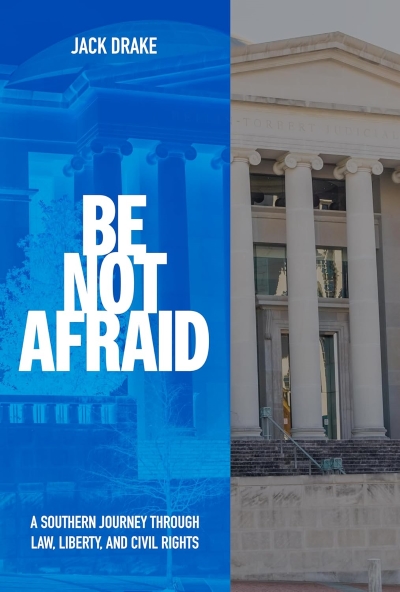
Sometime in the late 1960s, my father took a side job printing a freshman booklet for the University of Alabama. Mom and I were recruited to collate, and I spent several evenings walking around the dining room table putting together and stapling pages for the crimson-clad manuals. As a kid aspiring to a college career, I paid special attention to the pages. Near the front of the publication were letters of welcome from two current UA students: Don Siegelman, the SGA president, and Jack Drake, a law school student. The names stuck with me, and over the years, I watched Siegelman become a successful Alabama politician, and, eventually, the governor. Drake was an attorney in Tuscaloosa, litigating cases involving civil and patients’ rights, when I matriculated at the University of Alabama in 1973. I spotted him around town back then and, occasionally, years later, at Birmingham Museum of Art events. We never met, but after following his career over the decades, I was curious to learn more about the writer and the backstory when Drake’s memoir, Be Not Afraid, was recently published.
The book’s subtitle refers to a “Southern Journey,” but the events recounted truly document a Southern awakening. Drake describes hardscrabble origins – abandonment by his birth father at six months, adoption by his mother’s second husband, parents moving around to various houses and jobs. The Drake family eventually settles in Gardendale, a Birmingham suburb of the segregated South, surrounded by the everyday casual racism of the times. Jack was baptized in a church, First Baptist of Gardendale, “which actually voted in the 1960s to deny Black people the right to attend.” Jack shares the story of his uncle, Bob Jackson, who taught him how to fly fish. Uncle Bob tried to teach him how to scull a boat, too, but that task “was far too advanced a skill for a boy who had so little technical sense that he became a lawyer.” Drake acknowledges the basic values, the prejudices, and the contradictions of his upbringing. He finds that the contradictory beliefs taught him how to live in an America full of its own contradictions.
Jack can tell you the exact moment he stopped saying the N-word.
In fact, Jack Drake’s steadfast rejection of racism forms the crux of an impressive legal career, which he presents humbly, without much self-aggrandizement. His time at the University of Alabama spans the Civil Rights Movement and the growing anti-war movement incited by Vietnam. By the time Drake graduates from law school at Alabama, he is an activist in progressive politics and human rights, ready “to change Alabama, the country, and the world.”
After law school graduation, Drake launches an active legal career working with Episcopal priest Francis X. Walter and others in the Selma Inter-religious Project, assisting with issues in the larger Black Belt region. He was part of the landmark Wyatt v. Stickney case dealing with care for mentally ill and challenged Americans in Alabama, a ruling which has a lasting impact ever since. He represented the “Lost-Found Nation of Islam” in a land dispute over property in St. Clair County, Alabama. Drake challenged the idea that “sovereign immunity” could be applied to all state employees and represented United Mine Workers of America to litigate cases in the workers’ interest. He represented Alabama lieutenant governor Bill Baxley in a tumultuous case involving crossover voting in the 1986 Democratic Primary.
Readers who have followed Alabama political and legal matters in the last quarter of the twentieth century may be familiar with some or all cases. Drake lays out the issues in crucial legal cases and highlights colorful encounters along the way. In the process, he illuminates behind-the-scenes details that might be surprising. Attorneys George Dean, Ralph Knowles, and Chuck Morgan are standouts, along with Judge Frank Johnson. When Ruth Johnson, Judge Johnson’s wife, snubs Drake at an event, he decides it is because she disapproves of his moderation since the time when they first met – that he is no longer the “outspoken, antiwar Jack Drake [her] son idolized.” We learn that conservative firebrand governor George Wallace was “deeply troubled by the death penalty” and would take steps to avoid signing execution papers. Drake shares the details of the bread pudding recipe of Estelle Witherspoon, one of the Gee’s Bend quilters.
In the book’s Epilogue, Drake says, “I now think that deciding what not to write is essential to the writing of any memoir.” That is true, but it’s also true that there were times while reading Be Not Afraid when I wanted to learn more. By the time the book finishes, Jack Drake has made a powerful statement of his vigorous personal faith, its impact on his life and career, and the writing of his book. He is unable to reconcile that faith with the segregated churches of his youth. Drake was a force during a pivotal time in the story of the United States, and particularly of Alabama. His awakening and action should strike a chord with those who lived through those turbulent times and ring alarms for the turbulent times we face today.
Edward Journey, a retired university professor and theatre professional living in Birmingham, regularly shares his essays in the online journal “Professional Southerner” (www.professionalsoutherner.com).




Leave A Comment
You must be logged in to post a comment.