
Central Avenue Poetry, 2025
Cloth: $19.00
Genre: Poetry
Reviewed by Foster Dickson
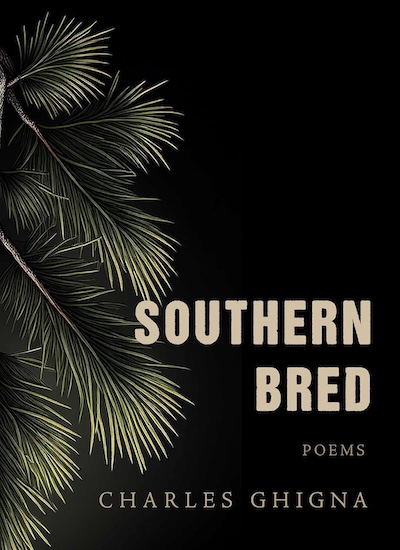
For those who are accustomed to associating Charles Ghighna’s name with Father Goose . . . this isn’t that. Ghigna is an accomplished poet whose publications range from The Father Goose Treasury of Poems for Children to inclusion in Harper’s and The New Yorker. His newest collection, Southern Bred, is a slim volume of mostly short poems – definitely for adults – that haunt the imagination with what is left unspoken. The text on the back cover describes them as “gothic poems” steeped in the Deep South, and the pages bear that out.
The first section opens with the title poem: “Southern Bred,” a brief, imagistic verse about killing a chicken on a stump, which ends with the speaker’s ominous shadow on the bird’s neck. What follows is “1952,” and we get a bit of grounding in real time for the voice and its stories. The speaker was six years old then, and soon we meet “Jimmy’s Dad,” a gas station attendant in gray overalls, who is dead in the poem that follows it. A few pages later, the speaker’s own brother dies, and he thinks “about how my brother was going to miss my birthday.” These are scenes of a boy’s life in the post-war South: hunting, reading, oak trees, basements, friendship.
The second and longest section takes on a less-direct quality; the poems become somewhat longer, and many are structured in three-line stanzas. The speaker is less obvious; the opening line of the first poem, “Signs,” reads, “I am the back of the attic mirror.” Later, “The House on the Cliff by the Sea” begins by telling us, “I come Ishmael to you from the midnight sea.” Dreamy descriptions appear, and even one “Night Mare,” as the imagery and metaphors cascade past: electrocution, bull riding, skydiving, a priest, a balloon, a porcupine. Perhaps conjoining the life of a poet with this long past, seemingly rural, definitely Southern life that he is now exploring, Ghigna writes in “Poem Hunter”: “With pen for gun / I enter the field / and stream / of consciousness.”
As one might expect in a book about a Southern boyhood, the first three poems in the third and final section are dedicated to the poet’s late father. In “The Bass Fisherman,” we learn what “type” of man he was, and through “Pitching Horseshoes” and “Best Man,” a portrait becomes more fleshed-out— “To me he was more than just a father.” A sense of closure takes over in this ephemeral narrative in “Taking Turns,” which alludes to the deaths of the speaker’s parents, and “Cleaning Out the Closet,” which is a “private place where all our regrets / hang like old suits in the dark.” In the end is a ditty made up of short-rhyming lines, a poem that could sound childish, though its sentiments are not, telling us that this land of memories and dreams is “where I most / want to be.”
Reading Southern Bred reminded me of a phrase that Albert Murray used in his novel Train Whistle Guitar, when describing his child main character’s sense of time and memory: “the hereness and nowness of it all.” Like Murray’s narrative, the feelings in these poems exist within a sense of time for which measurable time does not matter. When did these things happen? During boyhood. And did these things actually happen, or were they imagined . . .? Yes. So, to reflect on them and to attempt to share them with others who weren’t there means wading into an internal expanse that contains the real and the unreal, the clear and the faded, the relatable and the indescribable, all of it simultaneously incomplete and intermingled. Charles Ghigna does a fine job here, carrying us into that dim place and letting us see what we can.
Foster Dickson is a writer, editor, and teacher in Montgomery, Alabama.


Leave A Comment
You must be logged in to post a comment.