
Secret Histories: A New Era in Constance Fenimore Woolson Scholarship
Edited by Kathleen Diffley, Caroline Gebhard, and Cheryl Torsney
University of Georgia Press, 2025
Paper: $29.95
Genre: Essays
Reviewed by Katharine Armbrester
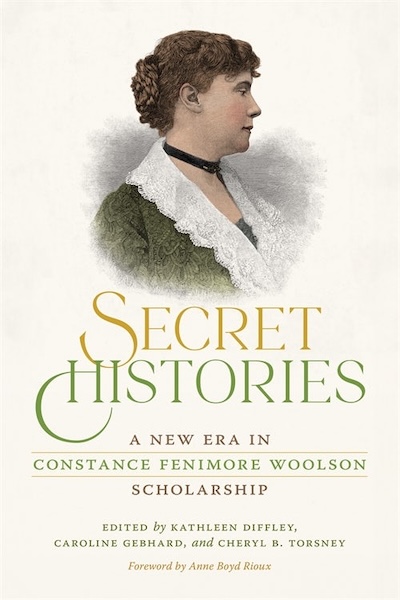 Secret Histories: A New Era in Constance Fenimore Woolson Scholarship is a much-needed collection of critical essays about the overlooked Victorian writer and contains a fascinating essay by Alabama’s own Dr. Caroline Gebhard.
If you are accustomed to reading literary nonfiction or biographies, “woman in the shadow of a great man” is as frequent a motif in the life of a famous writer as are lonely childhoods filled by voracious reading. After more than a century, the name of Constance Fenimore Woolson is still rarely mentioned without reference to her great-uncle, the author of The Last of the Mohicans, or to Henry James, a fellow wandering expatriate and longtime friend.
But Woolson left behind a wide-ranging oeuvre of stories, novels, poetry, and travel writings, depicting locales as disparate as the Deep South, the Great Lakes region, Cairo, and Italy, all with an observant and compassionate eye. Contemporary critics admiringly compared her writing to that of both James and George Eliot. Offended reviewers harped on Woolson’s realistic depiction of domestic abuse in her novel Jupiter Lights, and her rendering of extramarital passion in East Angels. Of Woolson, James wrote: “She is interested in general in secret histories, in the ‘inner life’ of the weak, the superfluous, the disappointed, the bereaved, the unmarried.”
One of the most fascinating essays in Secret Histories, “Dear Mr. James,” compares James’ satire of the nascent women’s rights movement in his novel The Bostonians to Woolson’s fourth novel Jupiter Lights. Both works depict intense friendships between women, but Woolson’s novel is arguably a direct response to James’ misogyny cloaked in purple prose, which she addressed in a letter to “The Master” himself.
“Why not give us a woman for whom we can feel a real love…I do not plead that she should be happy; or even fortunate…but, at any rate, let her love, and let us see that she does, do not leave it merely implied.”
After reading Woolson’s earnest cri de Coeur, one would have to read James’ later novels to judge if he took her words to heart and wrote more complicated women characters following her admonishing letter in 1883—but it might be a more rewarding effort to start reading Woolson instead and see if she followed her own advice.
Gebhard, professor emerita at Tuskegee University, co-founded the Woolson Society along with other Woolson scholars (including Lyndall Gordon, the superb South African-born biographer of James and Virginia Woolf) at Rollins College in 1995. Gebhard’s essay is the highlight of Secret Histories’ second section of essays, Postbellum Souths. She opens “The Confederate Widow of Myth and Artistry: ‘In the Cotton Country’” with a searing quotation by William Tecumseh Sherman. “I doubt if history affords a parallel to the deep and bitter enmity of the women of the South. No one who sees them and hears them but must feel the intensity of their hate.” As an academic, Gebhard has undoubtedly encountered that well-documented yet little-taught hate in her many years of studying primary sources; as a professional “Yankee” woman with Abolitionist sympathies traveling the postwar Deep South, it’s a hate that Woolson would have confronted firsthand.
Dr. Gebhard considers Rodman the Keeper: Southern Sketches (1880) the most significant of Woolson’s writings about the postwar South, and “In the Cotton Country” the most important story in the volume. Woolson briefly lived in the South before Reconstruction’s end and witnessed the far-too-brief upward mobility of freed Black men and women, and the corresponding rise of white anger and the development of “lost cause” mythology. Despite her documented support of Abolitionism, Gebhard reveals that Woolson succumbed to elements of the latter.
Gebhard eloquently argues both the strengths and troubling weaknesses of Woolson’s portrayals of postbellum women. In her short story, Woolson depicts a vibrant but deeply flawed confederate widow, drawing a complex portrait of an embittered woman who has lost everything that she was taught was her birthright. Gebhard’s exhaustive historical research is seamlessly blended with her literary criticism: just one example is when she discusses the prevalence of Southern war widows—one out of five white Southern women was a war widow, as opposed to one out of nine Union widows.
Unfortunately, in the character of “Cassy,” Woolson resorted to the “mammy” stereotype that poisoned Southern literature like a toxic kudzu for decades to come. Be sure to read all the footnotes of Gebhard’s essay, in which she explains the prevalence of the so-called “Plantation School” of writing, which promoted the persisting myth that enslaved people were typically treated as “family,” and what likely influenced Woolson’s portrayal of Cassy.
Anne Boyd Rioux, the author of a highly praised 2016 biography of Woolson, wrote the foreword for both Secret Histories and Constance Fenimore Woolson: Collected Stories, published by the Library of America in 2020. A collection of literary essays centered on an author (when equally researched, intellectual, and enticing) should make the reader itch to read more about the subject.
In her foreword, Rioux writes: “This renewed appreciation comes at a time when the wider reading public is hungry for work by lesser-known writers, especially women.” Reading Secret Histories—and particularly Gebhard’s essay—will ensure that Woolson’s writing is added to your to-read list.
Katharine Armbrester graduated from the MFA creative writing program at the Mississippi University for Women in 2022. She is a contributor to Alabama magazine, Alabama Heritage, and the Literary Ladies Guide, an archive dedicated to classic women authors.

Leave A Comment
You must be logged in to post a comment.