
Brick Road Poetry Press, 2023
Paperback: $16.95
Genre: Poetry
Reviewed by Jason Gordy Walker
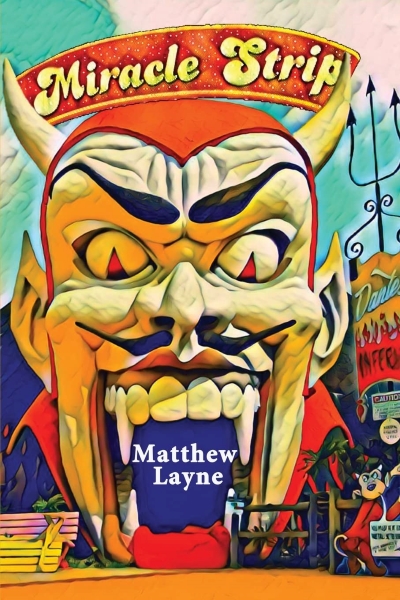
Matthew Layne’s poetry has received much recognition in the Alabama literary scene since the release of Miracle Strip, his debut collection totaling fifty-seven poems, in 2023. The Alabama State Poetry Society named the collection its 2024 Book of the Year, and Layne also received the 2025 Alabama Author Award for Poetry from the Alabama Library Association. A founding member of the controversial poetry collective The Kevorkian Skull poets, active in the 1990s, Layne has long championed both spoken and page-based poetry—so how fitting that the book includes a QR code for each poem. Layne’s mostly relaxed reading voice pairs nicely with modest instrumentals by local musician Ned Mudd. I insist, however, that the poems are best appreciated on the page.
Rooted in his home state, Layne’s poetry examines a childhood of “jarred fireflies” and “moon-wet grass,” a parenthood that offers comfort through language, the irony of Christianity in the Deep South, the desire for the beloved, and, by book’s end, the grief of losing a father. The moods span from gracious to nostalgic, humorous to satirical, ecstatic to contemplative, and Layne’s style, which values clarity and pathos, feels welcoming. His best poems— “At the Alabama Folk School for Writers & Musicians,” “Easter Vigil 2006,” “If Not,” and “Red Mushrooms on a Forest Floor”—rely on simple diction and visual imagery. Because they focus on meaning-making, such poems feel humble in spirit and honest in voice.
Although several poems stray into sentimentality (“kiss” appears too often, for example), I can appreciate this poet’s willingness to risk vulnerability. Despite the book’s hellish cover art, the poems do not reek of the demonic, but rather smell like “Southern food, Southern soul, raised up Southern hard.” The poet’s Southern-ness, as homegrown as it is, has a cosmopolitanism about it. Layne has spent as much time learning about the Notre-Dame Cathedral of Paris as he has St. Andrew’s Episcopal Church in Birmingham, Alabama. The poet-speaker’s relationship with religion comes across as skeptical yet faithful, observant yet naïve, sometimes humorously blasphemous, other times authentically reverent. He has a tender disposition toward family, friends, and romantic interests. More often than not, Layne aims to praise whatever beauty he can discover, or remember, “in a broken-bottle world.”
“Red Mushrooms on a Forest Floor,” addressed to the poet-speaker’s son, illustrates Layne’s aptitude for exploring the natural world:
Late summer. The katydids sing louder
than the seethe of the television, and I’m grateful
for their song. I walk out through the shuffle
of dry leaves, and over the stream that slowed
to a trickle this summer, past where the houses end.
He goes on to describe mushrooms “. . . fiery / as the orange velvet ants . . .,” remembers being stung by one of those ants once, and claims to offer “no comfort” for his son, though surely comfort is what he provides: “May you blaze with the audacity of a red mushroom in twilight.” The speaker does not specify his son’s struggle, but I sense that, whatever it may be, it is important enough for a proper poem—the whole piece imparts wonder, if not inspiration.
Writing to his late father in “In Absentia,” the poet-speaker sits at “the Mister Kleen Car Wash,” reading “. . . a poem / about turtles and swans and the dark spots death leaves behind . . .” while he waits to “. . . not be / identified by name but by car . . .” Between reading and idling, he recalls a curious tale about a prince and a fox as he attempts to reach out to his father to no avail, of course, concluding that:
All this is to say, that the thought of a wheat field shining without you
in its midst seems like nothing more than a waste of words.
Many a contemporary poet has written about the failure of language. Needless to say, it cannot revive the dead nor save the world. Layne understands language’s many limitations and chooses to write anyway, not so much out of defiance as out of a love for the world, dangerous and beautiful in its fundamental nature. “If Not” uses anaphora and apophasis to build a bittersweet atmosphere; the speaker and his lover navigate the winding roads of Appalachia until the speaker concludes “if not for all this and the moon, now rising, / this world would hardly seem worth it.”
Fans of Kathryn Tucker Windham’s folk tales will appreciate the references in Layne’s “13 Alabama Ghosts and Geoffrey”; film buffs may slip on a banana peel in his version of “City Lights”; and stand-up comedy enthusiasts will chuckle along with “Baby Jesus.” For my money, however, the strongest poems happen to be the most serious ones—poems that speak of pain, mortality, grief, and an unquenchable yearning for connection with humanity and nature—though even these works never feel too serious. At heart, Matthew Layne is not a grim poet but a hopeful one. He is well-read but not haughty. Miracle Strip delights in empathy, wit, memory, and lightheartedness despite the darkness and loss we all face.
Jason Gordy Walker is a poet, writer, and translator who lives in Alabama. His reviews and interviews have appeared or are forthcoming in Asymptote, Birmingham Poetry Review, Poetry Northwest, and elsewhere. He has received support from the New York State Summer Writers Institute, Newnan Art Rez, and other institutions, and holds an MFA from the University of Florida.


Leave A Comment
You must be logged in to post a comment.