
Hub City Press, 2025
Paper: $16.95
Genre: Poetry
Reviewed by Taylor Byas
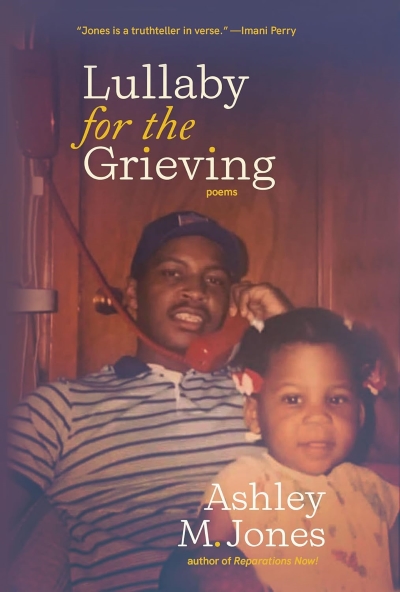
What is the purpose of the lullaby? By definition, a lullaby is a song meant to send someone to sleep—within the word, the verb “lull” also hints at its function. Ashley M. Jones’ Lullaby for the Grieving is itself a song that seeks to soothe us as the many-faced monster of grief waits under our beds.
Jones wastes no time getting to the point. The book opens with the poem “What It Really Is,” a self-identified “american acrostic,” and the first letters of each line together spell out “critical race theory.” The ambiguity of the “it” in the poem’s title makes room for a double interpretation of the poem. On the one hand, the “it” is America, and the foundation of it is critical race theory, understanding how racism is embedded in American society. On the other hand, the “it” is grief, and its true nature stems from being a Black woman in a world that oppresses her from every angle.
Part of the brilliance of this book is how it simultaneously supports both of these readings. While many of the poems focus on Jones’ home state, Alabama, she makes it clear that the problems of “the South” are not isolated. In “A Meat and Three for the Jubilee,” she writes “brother malcolm told us anything below canada was dixie— / so here we are at your red open mouth / in salt lake city, / in seattle, / in portland— / not as hot as alabama, but inferno all the same.” She confirms the pervasiveness of racism while also naming it as the hell we cannot escape.
Grief is timeless in Jones’ hands. Jones confronts racism in the here and now—in the doctor’s office with the doctor’s racist measurements, on the streets where a white man eyes a young Black girl—but she also acknowledges its historical and global impact. In “Conflict/War,” the epigraph reads “for Gaza, for the Trail of Tears, for Jim Crow and slavery, for the far reaches of colonialism and its violent scythe” before the poem begins “This is a brutal place. We blame the dead for their dying.” Again, Jones uses ambiguity to her advantage. To what do we assign “this” in the opening line? “This,” as in America? “This,” as in the marginalized body? “This,” as in the ever-changing shadow of grief? The formula works with each variable we plug in.
And speaking of grief and its complexity, Jones illustrates how Black women must make space to grieve their own personal losses amidst the everyday grief of living in a racist world. The first poem about the loss of Jones’ father is a “Grief Interlude,” the first of many scattered throughout the book. The titles of the poems suggest how they operate within the larger landscape of loss—the grief for her father must intervene, must shove to the front of the line. These moments in the collection are noticeably quieter, slower, and mostly contained within square prose poems. This formal distinction also feels like a hint towards intention. Contrasting the messiness of other grief (lineated, indented, formally experimental even), the neat prose squares of the Grief Interludes seem to demonstrate the very space the speaker has cleared to make room for thoughts of the father. Entering each interlude felt like stepping into a small, soundproof room, all of the outside sound drowned out.
The lullaby soothes. The lullaby lulls. The lullaby also gives us strength. This book argues about the usefulness of confronting grief head-on and articulates that making room for grief is also making room for healing. As the Grief Interludes keep appearing, Jones’ grieving for her father begins to bleed into other places, no longer contained within the specific series. The Grief Interlude poems themselves also begin to transform. “Grief Interlude VII” is not a square prose poem but a villanelle, a form that requires the renewal of language and, by extension, feeling. Jones’ grief slowly evolves into something that looks like hope. “On Entering the New Year Without My Father,” a golden shovel after Lucille Clifton, ends with the lines “surely, / someday, I’ll awake to these empty days, certain that things will / look more like light, that the answers to my prayers will come.”
Formally sharp and emotionally profound, Jones’ collection shows us what it means to make and take up space, and how we might find healing inside of permanent grief.
Dr. Taylor Byas, Ph.D. is a Black Chicago native living in Cincinnati, Ohio, where she edits for multiple publications. Her debut full-length, I Done Clicked My Heels Three Times from Soft Skull Press, won the 2023 Maya Angelou Book Award, among others. Her second full-length, Resting Bitch Face (2025), was a September pick for Roxane Gay’s Audacious Book Club.


Leave A Comment
You must be logged in to post a comment.