
Hub City Press; 2024
Paperback: $17.95
Genre: Short Stories
Reviewed by Edward Journey
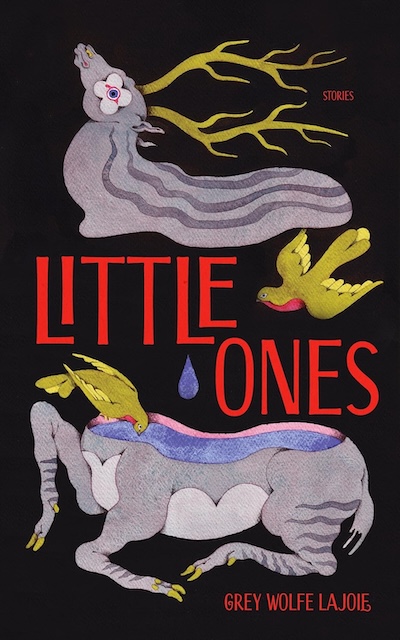
Scattered here and there are folk art installations that defy description but create a lasting impact with surprises around every corner. Howard Finster’s Paradise Garden in Summerville, Georgia, comes immediately to mind. Butch Anthony’s Museum of Wonder Drive-Thru in Seale, Alabama, is another. Joe Minter’s African Village in Birmingham. Sam Rodia’s Watts Towers in Los Angeles. Brother Joseph Zoettl’s Ave Maria Grotto in Cullman, Alabama. Reading Grey Wolfe LaJoie’s short story collection Little Ones feels like that. One never knows quite what to expect next, but it is sure to be strange, visceral, and fantastical, and will linger in memory.
Little Ones, LaJoie’s first collection, is published by Hub City Press out of Spartanburg, South Carolina. Over time, I have discovered that Hub City publications are reliably intriguing, and Little Ones is definitely in that mode. While reading Little Ones, there are occasional brief reminders of other writers. Gertrude Stein might be evoked by La Joie’s celebration of words; Sam Shepard in the desperate plight of many of the characters; Barry Hannah in the raw and inventive gonzo spirit of the language; and a memorably heartbreaking dog that would be right at home in one of Brad Watson’s dog stories (“Through the dog’s damp eyes the men are born,” LaJoie writes). The fact that the previous list includes some of my favorite modern writers is not to imply that LaJoie does not have their own distinctive and multifaceted voice.
Indeed, LaJoie’s literary voice is audacious and unique, unnerving and delightful. The narrative and character voices show a wide range in their naïve wisdom and otherworldly tales. Some of the stories do wild experiments with format – a comic strip, a pamphlet, a Wikipedia bio, a child-like scrawl, a lengthy questionnaire (“6. Tell me a little about your dreams.”; “11. Why are you looking at me like that?”). Some selections feel like filler, but all have something to appreciate, if only the clever workings of the writer’s mind. And word choices and sentence structure are entertaining throughout.
Dreams occur frequently in LaJoie’s writing, as do stories within the story. “Work” is about a man whose work is to release doves at funerals. When he spots a large owl watching from a nearby tree and refuses to release the doves, his livelihood is put in jeopardy. In “Snek and Goose,” Snek is a snake and Goose is a goose and Goose tries to comfort Snek, who has “the bad feeling,” with a story that includes a character with ”schizophrenia and six B.A.s.” and another who buys Evan Williams “elixir” in miniatures because he “did not wish to acknowledge the need for a pint.” In “Ampersand Jansen,” the title character’s spiteful horse named Hat steals the show at a funeral when a church spire begins to emerge from her heart.
“Idly” finds a worker at the Super Center meat counter dealing with a special customer amidst the looming chaos of “angry hordes.” Suffering from “too much ennui about myself” as a ringing phone causes “a thickening ambient welt in my head,” the worker expresses repressed yearning for love amid creeping and universal despair. In “Baby,” “a handful of addicts” with nothing to hope for help an old man remodel his house. The pamphlet, “How Come All the Schools Shutted Down,” is “a guide for children living in the end times” that is often horribly humorous. The reader is assured that “MOMMY and DADDY can’t help you … That doesn’t mean that they don’t love you.”
“Beautiful, moronic men huddle together chanting indecipherable things toward a television …” is the promising opening line of “Delivery,” in which a patient and long-suffering dog wanders the uneasy world of humans, seeking a safe place and some sense of redemption. We meet an exceptionally laid-back pontiff, bumming cigarettes, in “Interview with the Pope.” Further on, “Interview with Horsie” is written as a child’s essay. “Maria,” the story of a world-weary and precociously morose child, is the longest selection in the book. It chronicles the activities of the title character and her brother, a closet poet. During story time, Maria realizes that “some things really do not need our insistent praise.” On running into children dressed for Halloween, a horrified Maria says, “are these my … colleagues? … You need to get us out of here, now.”
“Unfished, Unfinished” is a comic strip about agency and the creative process (maybe). A nebulous creature, Sunset, wanders around, avoiding being consigned to the trash in “A Whole Nother World.” “Mention of Flesh” is an entertaining story about the daily activities of a man who works in corporate for Tacos Tacos Tacos and his daughter, Mercy, who spends her time watching reality shows. One of her shows, “Mafia Bakers,” features a prison guard zesting a lemon for Whitey Bulger’s torte.
In “Aisle Six,” a sinner – a lost soul full of rage and fear – carries on a conversation with his steak and ends up at a grocery store where the shelf items begin to berate him. (I just reread that sentence; please don’t stop reading. It’s a good story.) In “A Tale for Children, Told by Mister Jasper,” the narrator tells of his feral cousin Gracie, raised by coyotes. Jasper goes underground to spend a week with the coyotes, to observe their ways. “Going” details the intense thoughts of a sick man in a hospital room. He has beautifully evocative memories of a youthful airplane flight to Europe – the ocean, the sun, the darkness. “Frank” is the long goodbye of the final decay of a road-killed raccoon.
The first story in Little Ones, “The Locksmith,” is the best. I found myself wishing that story had been saved for last so the reader could enjoy the build. The prose is direct, deceptively simple, as the locksmith goes through the routines of his day. “The locksmith does not have friends. He has a pit bull terrier,” with whom he coexists on a tentative and distant basis. He rescues newborn opossums that he finds on a railroad track with their dead mother. He contemplates the idea of “zero.” Is it a presence or an absence? He watches videos on the subject late into the night.
Grey Wolfe LaJoie, a North Carolinian with an MFA from the University of Alabama, is a generous writer. They afford the same respect and agency for their non-human subjects as humans. The cadence and simplicity of their stories is often reminiscent of a story told to a child. The chant-like rhythms captivate. Their direct and deceptively simple prose may lead a reader to think “I could’ve written this.” To which the only response might be Well, why didn’t you?
Edward Journey, a retired university professor and theatre professional living in Birmingham, regularly shares his essays in the online journal “Professional Southerner” (www.professionalsoutherner.com).




Leave A Comment
You must be logged in to post a comment.