
Penguin Random House, 2025
Hardback: $20.99
Genre: Contemporary Fantasy / Young Adult
Reviewed by Dr. Candice N. Hale
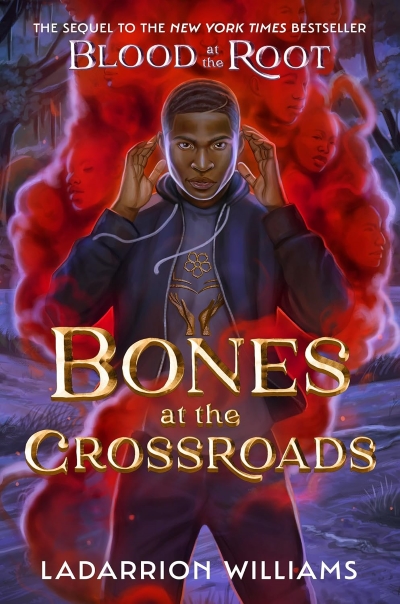 In Bones at the Crossroads, the rousing sequel to Blood at the Root, LaDarrion Williams brings readers back to Caiman University for a story wielding more secrets and betrayals than Malik Barron can handle. Although Malik is continuing his studies as a budding Black conjurer at his HBCU, he cannot release the abandonment, hurt, and trauma that characterized his life before this journey. He is on a mission to understand not only his powers at Caiman but also his true legacy.
In Blood at the Root, we see how quickly Black Boy Joy is extinguished. Malik carries the weight of societal expectations for Black boys alongside his own trauma, abandonment, and pain. So, when Malik finally meets his grandmother and gains access to the prestigious Caiman U to hone and perfect his magical abilities, he learns to be happy, cultivates new friendships, discovers himself, and enjoys Black boyhood. Yet, that joy is short-lived. Chaos and calamity find him once again, and Blood at the Root ends in death and destruction. Bones at the Crossroads picks up where the first book left off, and Malik holds up a mirror to the broken fragments of his reality—Black Boy Joy comes with pain, too.
While college can be a challenge for most students, Malik’s responsibilities seem impossible. He is simultaneously juggling several responsibilities: demanding magical courses, grieving the loss of loved ones, maintaining off-campus relationships, joining a secret elite society of ancient magic and ritual, protecting Caiman U from dark forces, and even battling his own mother, who will stop at nothing to destroy the foundation and future of the institution. Buckle up, readers, because Malik and his mother will face off, but is Malik saving only himself or the people and place now giving him direction and purpose?
At the nexus of this chaos, causing all the turmoil, is a magical scroll that Malik unknowingly possesses. His mother is ready to kill to get her hands on the scroll to right a wrong in her past, but at the expense of Malik’s life. The tension between Malik and his mother builds. Students begin to disappear, and tensions rise. Malik is forced to confront not only the threats around him, but also the fractured relationships within his newly discovered family—including a relationship with his legendary uncle, John Henry, and the long-awaited truth about his father.
It’s not magic or happenstance that from the first book to the second, readers recognize Malik’s character development. It’s simply what happens during adolescence: learning from mistakes and everyday experiences. Malik grows in confidence and emotional depth, and the supporting cast—especially Dom, Taye, and D-Low—are given space to evolve. Williams’ continued inclusion of queer and trans characters serves as a beacon for belonging, acceptance, and nonconformity. In a pivotal scene, a member of the queer community shouts over the intercom at the homecoming game, “No one is free until WE ALL be free.” The dialogue provides readers with a much-needed link to larger and broader conversations within the queer and trans community. When the conversations represent authentic, lived experiences that promote honesty, integrity, and community, real change and resistance can occur, and Williams delivers and promotes that change here.
Williams’ series birth meaningful and powerful themes that span generations and communities across the United States, but, for far too long, Black boys have not been the center of these stories. Williams’ Black boys can coexist with pain and joy, and they become Black men who deserve every good thing. Williams doesn’t preach—he shows and exposes. “Sometimes you gots to lay ya bones down at the crossroads,” one character says, a line that encapsulates the novel’s exploration of legacy, choice, and transformation. Malik’s emotional journey is equally compelling: “I’m tired of being angry, I’m just tired of feeling like nobody don’t want me. I’m tired of being a victim.”
Any reader struggling with dialogue, AAVE, and slang in Williams’ series must understand that he is only representing the lived experiences and authentic identities of his intended audiences, as well as his racial and regional background as a young, Black boy from Helena, Alabama. Malik’s voice is key to understanding his maturity, identity, and Blackness. Let Malik be a kid and figure things out.
Overall, the novel’s structure is solidly divided into three acts, and the storyline is generally easy to follow. Some parts feel disjointed, and the pacing can be slow, mainly in Act I and in parts of Act II, but moving forward in Acts II and III, the climax and action accelerate full speed, taking readers full swing into the whimsical ride of fantasy literature. These minor inconsistencies don’t detract from the overall impact of the story. Of course, Williams ends on a cliffhanger, leaving readers eager for the next installment in the series.
Bones at the Crossroads is a hauntingly beautiful story about legacy, choice, and the magic of healing. “We get on by just fine, because the magic of resilience is in our blood. Nobody, and I mean, nobody can ever take that away from us,” Uncle John Henry says. It’s a necessary addition to the YA fantasy genre—one where Black boys are allowed to be messy, tender, powerful, and whole.
Candice is a part-time book influencer on Instagram, professor of composition and literature at Auburn University, and adjunct professor of Women’s Studies & African American Studies at the University of Alabama. In August 2023, she contributed to the edited collection Jesmyn Ward: New Critical Essays by Edinburgh University Press.

Leave A Comment
You must be logged in to post a comment.