
A Field Guide to North American Trees
Good Printed Things & Loblolly Press, 2025
Paper: $14.00
Genre: Poetry
Reviewed by Jason Gordy Walker
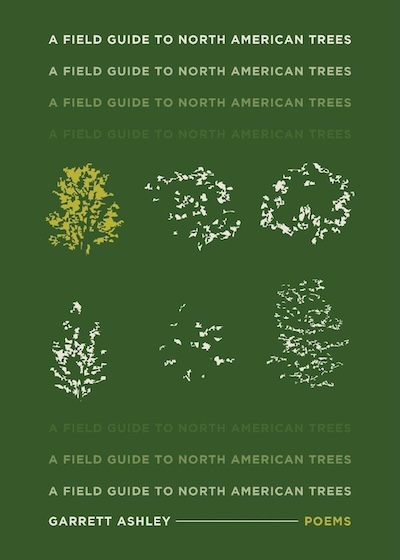
Alabama’s forests, and the many individual trees that constitute them—pine, oak, hickory, cottonwood, magnolia, birch, sycamore, and on and on—offer a colorful splendor stretching over 70 percent of the state. We ought to revere such a plethora of wooden beings, if not for their upright personalities than for their gift of sweet oxygen, a resource soon to be set up for subscription payments if the world’s feculent billionaires continue to trump our environment.
Garrett Ashley’s debut poetry chapbook, A Field Guide to North American Trees, respects and celebrates trees in fourteen poems: “Balsam Poplar,” “Red Spruce,” “Jack Pine,” “Ginkgo,” “Live Oak,” “Loblolly Pine,” “Poison Sumac,” “American Holly,” “Sweetgum,” “Longleaf Pine,” “Slash Pine,” “Tree of Life,” “Crape Myrtle,” “Red Juniper (Eastern Red Cedar),” and “American Sycamore.” Each tree-poem has been arranged in pieces. For example, “Longleaf Pine” contains six subtitled entries of varying lengths (sestet, octet, two quatrains, quintet, and monostich): Description, Needles, Bark, Cones, Habitat, and Range. As is the case with most poems, the parts are meant to add up to a cohesive whole, and they usually do. Furthermore, to contribute an extra layer to the book’s ecosystem, Ashley has written parts that sometimes function as individual poems themselves.
In general, the tone feels melancholic, somewhat nostalgic, with occasional sparks of whimsy. Through the lyrical “I,” the speaker conveys personal, sometimes even idiosyncratic, emotional responses not only toward trees but also toward what seems to be a recurring romantic partner, as well as family members, most notably grandparents, as seen in the two strongest poems, “Sweetgum” and “Tree of Life.” From the former’s Bark section:
Deeply furrowed. Gray, and in the summer
red like Alabama clay. I asked him about the scar
on his chin—
he got it throwing knives at trees.
This brief portrait of the grandfather has grit. When Ashley combines image with rhyme (“Gray” and “clay”; “in” and “chin”; “summer” and “scar”), then sound and sense work together most effectively. Although some contemporary poems elegizing dead grandparents can be as invasive as kudzu, Ashley’s feel relevant and direct, demonstrated in these lines from Range in “Tree of Life”:
When my grandmother died, I refused
to look at her body. Because I didn’t want
to see how she changed after clinging here
so long. I do not regret this in the slightest. She
is in good hands. If asked how I could believe in heaven,
I would say because she is there.
The diction: unadorned. The syntax: terse. By excluding verbal fireworks and instead relying on raw honesty, Ashley has crafted a powerful sestet. He would have done better to end-stop the fourth line with “slightest”—the effect would have been more impactful and surprising—but I’m willing to put minor qualms aside and trust the poet because his language holds meaning. Some readers may deem the last two lines saccharine, and fair enough, but I consider them well-earned; beneath the surface-level sentiment, these lines suggest a timeless philosophical question: Do we create our own afterlives simply by what we choose to believe? Perhaps the speaker’s grief has taken over; maybe the refusal to believe that the grandmother is not in heaven is a result of mere denial. But I view the speaker’s conclusion as valid as any other, and I’m persuaded to feel empathetic and accept such reasoning.
Other standout poems include “Live Oak” (“Ever green. A blanket / held against the base, we turn / into one of many. Long / branches, / a chord of ocean-bound fibers.”) and “Loblolly Pine,” which begins: “In an old field. Commercial, / Southern as Jesus Christ / with resin and bathroom / fragrance, the spread of arms . . . .” When the poet waters his roots, his images bend toward the light of environmental wisdom. Garrett Ashley’s A Field Guide to North American Trees has a structured integrity about it. Suffering imbues his voice, loss of love, loss of loved ones, but hope and curiosity and veneration for memory—qualities we could all use more of during this new dark age—seem to win out.
I look forward to reading Mr. Ashley’s poems again in his first full-length poetry collection, Habitats, when Loblolly Press releases it next spring.
Jason Gordy Walker is a poet, writer, and translator who lives in Alabama. His reviews and interviews have appeared or are forthcoming in Asymptote, Birmingham Poetry Review, Poetry Northwest, and elsewhere. He has received support from the New York State Summer Writers Institute, Newnan Art Rez, and other institutions, and holds an MFA from the University of Florida.


Leave A Comment
You must be logged in to post a comment.