
Jane Austen on Nature: The Novels as Pastoral Literature
By Mary Jane Curry
McFarland & Company, Inc.; 2024
Paperback: $29.95
Genre: Nonfiction
Reviewed by Katharine Armbrester
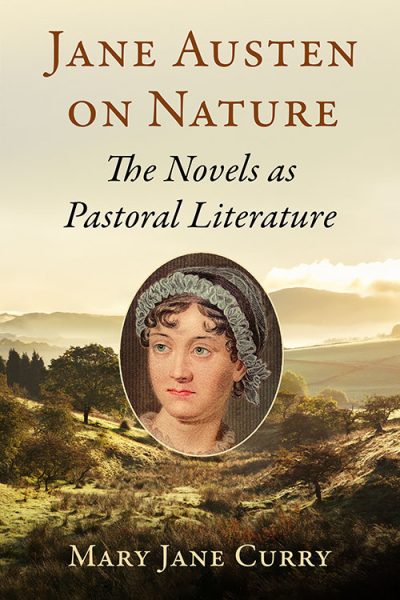
Perhaps, along with the romance and sly humor, another reason for Jane Austen’s enduring popularity is the escape into the English countryside that both her novels and their film adaptations offer.
Some of the most memorable (and humorous) scenes in Emma or the ever-popular Pride and Prejudice take place in gardens. One of the most picturesque—and funny, Austen is always funny—scenes in Ang Lee’s 1995 adaptation of Sense and Sensibility is of Kate Winslet’s character, Marianne, pulling her sister up a lusciously green hillside just before the skies open in a downpour.
In her first book, Jane Austen on Nature: The Novels as Pastoral Literature, Dr. Mary Jane Curry’s interesting argument is that Austen incorporated elements of “pastoral” fiction into her novels and that her heroines respond to the natural world around them as they learn about themselves and their burgeoning sexuality.
Pastoral literature, which Curry defines as the celebration of “the beauty of nature and nature’s beneficial effects on people…the literary expression of nature and our responses to it,” was immensely popular in Regency England. Curry’s knowledge of pastoral literature is exhaustive, and both seasoned readers of Austen and new fans will find much to enjoy in her first book. (But if you have recently begun reading Austen’s novels, be aware that the endings of multiple novels are given away!)
Curry argues that all of Austen’s heroines interact with their natural surroundings, with the most literary heroines—Fanny Price of Mansfield Park and Anne Elliot of Persuasion—quoting nature poetry from memory. Throughout her book, Curry elegantly proves her argument that Austen’s major works incorporate elements of pastoral literature “that show characters’ relationships to nature as dimensions of their moral and aesthetic principles.” Conversely, some of the most unpleasant characters exploit nature, reflecting their underhanded or downright villainous dealings with women.
When Austen’s heroines are emotionally distressed, Curry illustrates how they generally exit their domestic sphere with all due haste and escape to their gardens or a nearby grove of trees. “Austen’s heroines appreciate nature for the freedom it offers them—intellectual, emotional, and physical—to escape the confines of houses and rooms, with their social rules that hem them in as much as walls do,” Curry writes.
Perhaps most interestingly, she argues that, after spending time outdoors, the heroines are often resolved to act more sympathetically towards aggravating acquaintances and family, or towards perplexing suitors. This nature-inspired philosophy of generosity of spirit is a facet of Pastoralism that Austen perhaps learned from the poet William Wordsworth, who suggested that “Love of nature leads to love of man.”
Now enjoying her retirement in North Carolina, Curry was a founding member of the Alabama region of the Jane Austen Society of North America. She obtained her PhD in English from Auburn University and has published and spoken about Austen’s writing for thirty years; the publication of her first book caused considerable excitement both in her native Alabama and JASNA-North Carolina region.
One of the pleasures of the book is Curry’s eye for the memorable detail in Austen’s fiction and her own, very pastoral life, whether it’s the young Austen surveying the country while riding around in her donkey cart or writing vivid stories in the set of three bound notebooks that her indulgent father went to considerable expense to give to her.
Industrialism posed a new threat to “England’s green and pleasant land” in Austen’s lifetime, and Curry eloquently reiterates how Austen’s literature has something important to say to readers who are aware of the dangers of climate change. “On a universal scale,” Curry concludes,” Austen allows us a speculative gaze at threats to rural places and people.”
Devoted Austen readers can be thankful that Mr. Austen took pride in his daughter’s writing and encouraged her love of writing and the outdoors, and Curry will make readers of Jane Austen on Nature eager to explore the natural world around them and embolden them to find ways to preserve it. By the end of the book, readers may also find themselves longing to climb the nearest hill in a gauzy dress and well-trimmed bonnet.
Katharine Armbrester graduated from the MFA creative writing program at the Mississippi University for Women in 2022. She is a contributor to Alabama magazine, Alabama Heritage, and the Literary Ladies Guide, an archive dedicated to classic women authors.



Leave A Comment
You must be logged in to post a comment.