
Harper Muse, 2024
Paperback: $17.99
Genre: Historical Fiction / Climate Justice / Contemporary
Reviewed by Dr. Candice N. Hale
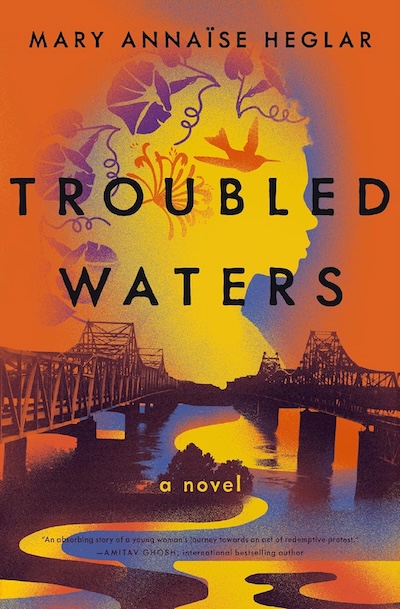
Mary Annaïse Heglar’s Troubled Waters is a compelling debut that merges historical fiction with a contemporary resonance on the urgency of climate justice, the power of Black liberation and defiance, and the intergenerational trauma of family. Set in Mississippi and New Orleans, with flashbacks to 1950s Nashville, the novel follows Corrine Sterling, a college student and climate activist, and her grandmother Cora, a retired teacher still haunted by her childhood as one of the first Black students to integrate a white school. Troubled Waters at its core is a skillful exposé on the neglect of Black women and how that neglect mirrors society’s disregard for the climate crisis and Black resistance.
Some books meet you where you are, and others follow you into the places you’ve tried to forget. Troubled Waters is one of those books. In forging Black womanhood, there’s an unspoken rule that Black women must be strong and silent to survive the wreckage and weight of pain, grief, and history. But as a Black woman, I know that this is a glaring falsehood. In Troubled Waters, Heglar’s characters confront pain and personal trauma they cannot bury, which rises and rises like the unpredictable flow of the mighty Mississippi River.
The Mississippi River is more than just a setting in this book — it is a living and powerful force. Both beautiful and brutal, the river symbolizes life and loss throughout the South. Heglar knows the power it embodies and the rage it carries. For Corrine, the river’s power is personal, a reminder of how joy clings to fragile spaces even as danger lurks beneath. She reflects on this delicate balance: “The laughter was the only thing keeping the city afloat, even though it was below sea level” (8). In that single line, the river becomes a metaphor for survival: a gravesite for her brother Cameron, lost to an oil barge accident, and a testament to the resilience of those living in its shadow. As a reader, this image haunts me: “She saw blood leaking from their wings, like crop dusters. She imagined the bodies of the unborn, untold generations in the baggage compartment.” Corrine’s vision follows her realization that jet fuel melts ice caps, linking environmental destruction to human suffering. It reflects a history where Black grief is tied to land exploited and covered in blood. As a Southerner, I can’t forget soil stained with Black bodies.
Corrine’s grief is sharp and familiar. Heglar explains, “Now, more than half a year later, she still carried a bottle of Xanax in her purse because her grief came and went, but when it came, it was ferocious” (12). Her pain is met with silence—especially from her grandmother Cora, who raised her after her mother’s death. But Cora’s quiet is protective, shaped by her own trauma. She was “used” to integrate a white school in 1950s Nashville, and as Heglar writes, “Blazing trails was lonely work” (73).
The tension between Corrine and Cora is the novel’s emotional core. While Corrine chooses activism, Cora was selected for it. Corrine sees protest as a way to honor her brother. Cora sees it as a risk too significant to bear. “You think I want to watch a video of you dying? You think I can survive that?” she exclaims. Cora’s trauma steers her fear for her granddaughter and is wrapped in love and risk. As both a mother and a daughter, I know how she feels in wanting to protect and care for a loved one. On the other hand, I know Corrine’s protests and fights for her brother come from the purest love and admiration. Neither character is wrong here.
Heglar doesn’t just tell a story—she tells the truth. Troubled Waters shows how environmental injustice and racial violence collide in Black communities, where people are often the first to suffer and the last to be heard. As Heglar writes, “Only Black people went to the camps; white folks went to homes and hotels. Black folks were refugees, while white folks were guests” (14). That line brought me back to Hurricane Katrina and the painful reality of disaster inequality. Like Corrine, many Black and Brown people in “climate-cursed” communities live with a constant sense of helplessness. “I see this tragedy of all tragedies coming from just around the corner, but I can’t do anything” (109), Corrine warns. The burden of knowing, of seeing what’s coming and feeling powerless to stop it, is a heavy weight to carry.
Troubled Waters makes evident that Black resistance is met with clear repudiation and disruption of order. Readers can witness the generational divide between Cora and Corrine as they reckon with the legacy of Black resistance. Cora’s lived experience is shrouded in fear and being a walking symbol and sacrifice for progress. Ultimately, Cora never had a choice in her resistance because it was for survival, whereas her granddaughter Corrine is rightfully choosing to be defiant. Corrine’s defiance opens up Cora’s wound, and pain oozes out: “So you just a mule and a fool, huh? You actually believe that shit? Girl, there is no such thing as a ‘strong Black woman,’” she mocked. “That’s some bullshit white folks made up to forgive themselves for treating us like dirt and working us like dogs. If you’ll believe that, you’ll believe anything, and I… I… just might have failed you” (220). In that moment, Heglar reveals the painful truth behind the myth of the “strong Black woman.” Cora’s words are not just about Corrine because they call in every Black woman who’s been expected to carry the weight of a movement, a family, a nation, without ever being allowed to rest. Cora is the beating heart of Troubled Waters, defined more by her strength than her humanity.
The novel also explores how trauma shapes relationships. “Two people can live through the exact same thing and come out changed in whole different ways,” Heglar writes. But Corrine and Cora show us that there’s no single way to survive. “She remembered that Uncle Harold said your pain is the only type of pain there is because you can’t feel anyone else’s.” That truth is hard to swallow, but it’s real. Healing, as Heglar reminds us, is not always gentle—it can hurt the people we love.
Troubled Waters takes its rightful place in the canon of eco-fiction, historical fiction, and Black literature. Much like the Mississippi River shaping the land, the novel flows through us, carrying stories grounded in soil filled with memory and grief. It gently reminds us that our becoming is deeply connected to what the Earth has shared with us. It moves through us like the soil in the Earth to recognize we are part and parcel to its own becoming. For any Alabama reader, this story will feel like home because the soil is groaning with our pain, our grief, and our healing. The legacy of who we become and the ghosts we inherit is only possible when we speak our truths and unearth what’s been buried.
Candice is a part-time book influencer on IG, freelance writer and reviewer, and professor of composition and literature at Auburn University. In August 2023, she contributed to the edited collection Jesmyn Ward: New Critical Essays by Edinburgh University Press.

Leave A Comment
You must be logged in to post a comment.