
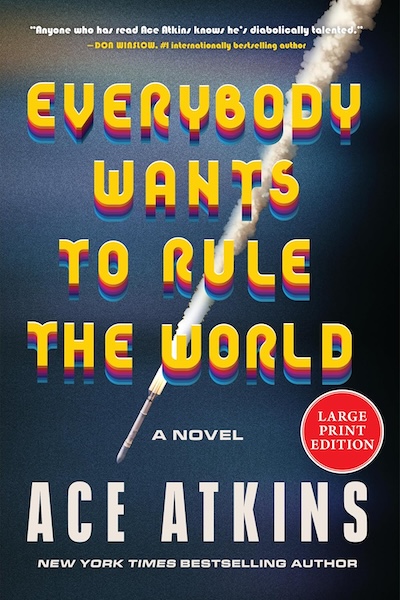
Everybody Wants to Rule the World
By Ace Atkins
William Morrow Large Print, 2025
Hardcover: $27.95
Genre: Crime, Thriller, Suspense
Reviewed by Lesa Carnes Shaul
When I interviewed Ace Atkins for First Draft in August of this year, he reflected on what it means to be a Southern writer in the twenty-first century:
I think the thing about being a Southern writer is that we’re always steeped in this idea that when you write about the South, it has to be the South of Flannery O’Connor and Hank Williams and William Faulkner…it’s complicated for people of our generation because I think we’re taught, if you’re going to write about the South, you’re writing about it in a Willie Morris way, like “I remember the boys coming home from the war” or somebody writing about growing up on the farm.
Atkins goes on to compare his father’s generation in the South to his own upbringing, saying that his grandfather and father were “Faulknerian,” but that he, as a Gen X teen, “lived in the suburbs in Georgia in the 80s”: “My dad grew up as hard scrabble as you could get…in my teenage years, I’m sitting there in the afternoon in the air conditioning, watching Prince on MTV.” In his earlier novels, the Quinn Colson series in particular, Atkins pays tribute to the ghosts of the Southern past, complete with lush, bourbon-infused descriptions of the Southern landscape and allegorical villains who embody the racism, corruption, and complex family ties that haunt the works of those looming giants of Southern literature.
While that Southern past is certainly not dead (as Faulkner says, “It’s not even past”), Atkins has turned his storytelling brilliance toward a time much more familiar to the current generation of Southerners and Americans in general. His newest novel, Everybody Wants to Rule the World, continues and enlarges the Southern literary oeuvre in much the same way that his previous book, Don’t Let the Devil Ride, departs from his fictional county of Tibbehah (the name in itself an Easter egg nod toward Faulkner’s Yoknapatawpha County) and transports us to the twenty-first century urban setting of Memphis, featuring an Ole-Miss-sorority-girl-turned-suburban-soccer-mom, an intrepid and smooth-talking Black private eye, and complicated webs of international espionage and intrigue. In Everybody Wants to Rule the World, Atkins moves from the Old South city of Memphis that he explores in Don’t Let the Devil Ride to the shinier New South city of Atlanta and its sprawling Sunbelt suburbs. The result is, as Atkins said in the aforementioned interview, “the most autobiographical book that I’ve ever done.” Welcome to your life, indeed.
Even though the following description defies the laws of physics, Everybody Wants to Rule the World, set in the annus mirabilis of 1985, is a reverse Russian matryoshka doll: instead of each successive layer revealing a smaller nesting figurine, what emerges is a larger—and far more global—internal entity. Unpacking EWTRTW is like opening a time capsule of American history, politics, and popular culture in the 1980s, as well as an homage to the vibrant and quirky underworld of late twentieth-century Atlanta. Fans of series like The Americans and Stranger Things will revel in this new novel; as Don DeLillo writes in Libra (another book that delves into American conspiracy theories), “There is a world inside the world.” We meet a kaleidoscope of characters: Vitaly, the lovesick and dyspeptic Russian defector who finds America both bewildering and alluring; Peter Bennett, a fourteen-year-old suburban kid immersed in the music, movies, and typical adolescent angst of his time, said angst compounded by the fact that he suspects that his mother’s new gym rat boyfriend is a KGB spy; Dennis X. Hotchner, a one-eyed, almost-famous writer of detective novels (loosely but lovingly based on the late Atlanta crime fiction writer Ralph Dennis) whose downturn in fortune has led him to shelving books at the iconic Oxford, Too used bookstore in Buckhead; Jackie Demure (née Jackie “Big Time” Johnson), a former Atlanta Falcons defensive end who finds post-NFL fame as one of the city’s most popular drag queens; Lisica, an enigmatic Russian operative and femme fatale intent on extracting secrets from employees of Scientific Atlanta; Sylvia Weaver, a Black female FBI agent and ardent Linda Ronstadt fan who has fled Grabtown, North Carolina, for the opportunities offered by the ”City Too Busy to Hate”; Dan Rafferty, a G-man turned double agent, working both sides of the 80s superpower tug-of-war while struggling to maintain his role as a devoutly religious husband and father; and, in the final chapter, Ronald Reagan, The Gipper himself (albeit a fictional reconstruction).
As the title indicates, everybody does want to rule the world, from Peter Bennett’s teenage microcosm of skating rinks and Spielberg movies at the local multiplex to the American and Russian governments’ cosmic quest for global dominance. The title also alludes to the epochal 1985 Tears for Fears song, which shouldn’t surprise Atkins fans in the least, given that all of Atkins’s works are suffused with music to such a degree that every novel he has published should have its own soundtrack (or, in twenty-first-century parlance, its own Spotify playlist). Jackie Demure belts out Tina Turner and croons Diana Ross; edgy teens scoff at the tunes of Huey Lewis and Michael Jackson while they play Metallica and Van Halen at ear-shattering decibels in their Camaros; Atlanta nightclubs thrum with the synth-pop beats of Duran Duran, Depeche Mode, and Prince. Even sketchy Gary, Peter’s mother’s boyfriend with the suspect Eastern European accent, waxes poetically about the ballads of Phil Collins. Atkins knows his music, and this novel showcases how astutely and passionately the author understands the connection between an era’s songs and the people who live during that period of history.
Lest readers of this review conclude that EWTRTW is simply an amalgam of 80s nostalgia, think again: Atkins is a superb writer and storyteller who can take a singular spot of time and magnify it to universality and timelessness. People have always feared global annihilation. Generations of children have harbored deep suspicions that their parents are hiding from them something monstrous and frightening. The great empires of the earth continue to thrive on conquest and the thirst for supremacy. Although the world of EWTRTW is modern and familiar, it’s still a place and time where the eternal human verities and foibles hold sway. Also, for devotees of Atkins’s Quinn Colson books and his earlier works, especially the classic noir novels like Wicked City, Devil’s Garden, and Infamous, Atkins has left neither noir nor the South behind. Instead, in Everybody Wants to Rule the World, we get a kind of “Neon Noir,” which may seem like an oxymoron, but it aptly describes this novel and its setting. Like the thousands of people who flocked to Atlanta in the latter half of the twentieth century, transforming the quintessential New South city into an international technopolis, we’re drawn in by the light and color, blinding us to the darkness it masks. Yet despite the subterfuge, murder, intrigue,betrayals, and lost innocence, there is much laughter, warmth, and companionship at the heart of this novel—it does, as the song says, make the most of freedom and of pleasure.
Lesa Carnes Shaul spent the first eighteen years of her life in a small town atop Sand Mountain in northeastern Alabama. She is a professor of English at the University of West Alabama and the author of Midnight Cry: A Shooting on Sand Mountain.




Leave A Comment
You must be logged in to post a comment.