
By Matt Nagin
Strange Rebel Press, 2024
Paper: $14.99
Genre: Fiction
Reviewed by Nelson Sims
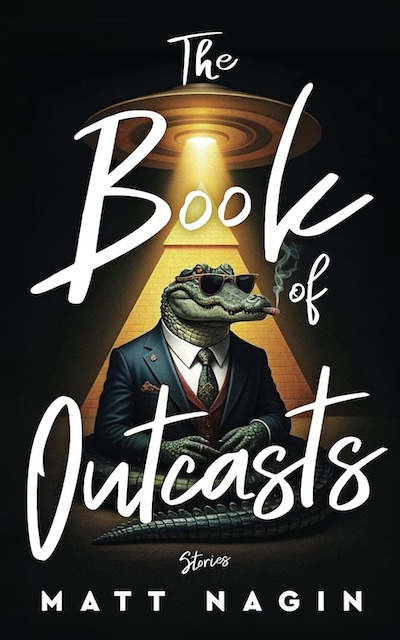 Matt Nagin’s The Book of Outcasts is a strange little collection of strange little stories. It’s bleak. It’s bone-dry. But it’s weirdly and sneakily absurd. These are stories about men on the outskirts of society, but not in the cool, misunderstood genius kind of way. No, these are the quietly unraveling types – men who drift through life like discarded receipts, wrinkled and unread. They are not, as one reviewer suggested, “behaving badly” so much as they are existing badly. And Nagin, to his credit, captures that particular flavor of male inertia with precision, dark humor, and the occasional blast of unexpected poetry.
The book is a collection of fifteen short stories, all focused on characters who either never got their act together or lost the thread somewhere along the way. One guy is forced into early retirement after a seemingly undeserved scandal and ends up in an apartment he can’t seem to keep to himself. Strangers wander in, drink his liquor, take over the TV, and one man repeatedly crosses personal boundaries with him… all while he just watches like a passenger in his own life. Another man, addicted to gambling and driven to casino robbery, actually wins enough to clear his debts and start over. But the streak doesn’t last, and by the end, he’s tortured and murdered by the ne’er-do-wells he owes.
The stories don’t build to revelations. Instead, they are preludes to collapse. Nagin’s writing isn’t interested in traditional narrative arcs or satisfying resolutions. These are stories about people who have waited too long to start reaching for a way out, if they start at all.It’s uncomfortable, sometimes maddening, but never boring.
There’s a delightful level of absurdity that runs underneath all the bleakness, and it’s part of what makes the book work. A woman catches her husband cheating on a cruise and retaliates with a cigarette and lighter fluid. Later, after a one-night stand with a wealthy passenger, she returns to her cabin and casually tells her husband they’re now “even.” They fall back into routine like it’s just another Tuesday. Another story, Nagin vs Nagin, pits a writer against his doppelgänger in a meta battle for authorship and reputation. The clone ruins his life, steals his ideas off the cloud, and eventually takes over entirely – until the other Nagin seduces his wife, and the cycle flips, again and again, as the cultural tide swings from cancellation to comeback and back again. It’s the standout of the collection – a sharp satire about self-destruction and reinvention.
Stylistically, the whole book hums with restraint. Even when something outrageous happens, Nagin tells it with the same flat, unhurried tone. There’s a distinct Catch-22 energy in the dialogue’s matter-of-fact exchanges that sound just a bit too strange to be real. One moment, you’re deep in existential dread:
“It didn’t matter whether you were a rabbit or tiger; we were all in an existential labyrinth, unlikely to find the Minotaur; we wandered ceaselessly, increasingly losing our way.”
The next, you’re hit with a gem I’ll remember for a long, long time:
“So many lunatics – and they all wanted deli meat!”
Somehow, both lines feel perfectly at home in this book. That’s the trick Nagin pulls off. He’s not just writing about disconnection. He’s writing in a way that feels disconnected, without ever losing control. He knows exactly what he’s doing. Even when the stories don’t land emotionally (and a few definitely float off without leaving much behind), you get the sense that every shrug, every silence, every unfinished thought is there on purpose.
It’s not a fun read, in the traditional sense. But it is a sharp one that left me laughing out loud more than once. The stories have a particular way of sticking with you – not because the characters are likable or the situations relatable, but because there’s a quiet horror in watching people who’ve been knocked flat by life and decided, consciously or not, to just stay down. If you’ve ever felt the pull of passivity, or recognized that particular kind of stuckness in yourself or someone close to you, The Book of Outcasts can hit a little too close to home – despite the presence of cannibalistic aliens in one of the more tragically vexing stories in the collection. Still, there’s something refreshing in the honesty. Nagin isn’t here to uplift or inspire. He’s holding up a mirror and letting you figure out how bad the damage is. For some readers, that’s going to be too much. For others, it’s exactly the kind of literary discomfort that sticks with you.
Nelson Sims is an English instructor at Wallace Community College Selma, where he shares his love of literature and writing with students. Outside the classroom, he enjoys crafting quirky stories, obsessing over 80s/90s pop culture, and consuming weird and wacky books, with the occasional comic book on the side. He lives in Alabama with his wife and their lively household of six animals—three dogs and three cats—who keep things interesting.




Leave A Comment
You must be logged in to post a comment.