
Blessings and Disasters: A Story of Alabama
Henry Holt and Co., 2025
Hardcover: $28.99
Genre: Memoir
Reviewed by Edward Journey
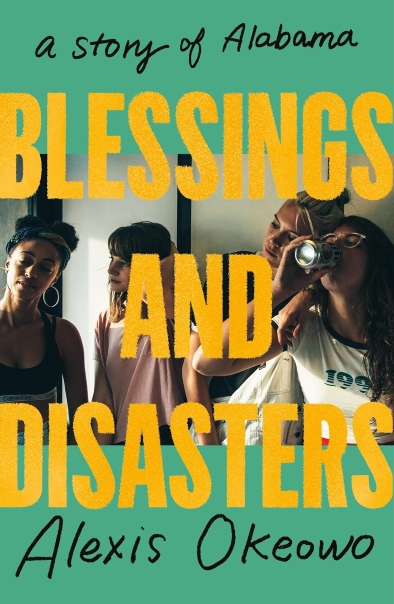 In June, I read an article titled “What Happened to the Women of #MeToo?” by Alexis Okeowo, a New Yorker staff writer. It focuses on Tina Johnson, one of the Alabama women who accused Judge Roy Moore of sexual assault during his 2017 U.S. Senate campaign. It was one of those stories that I found myself encouraging others to find and read, so it was a no-brainer when I was asked soon after if I had any interest in reviewing Okeowo’s new book, Blessings and Disasters: A Story of Alabama. I jumped at the opportunity.
Okeowo, the daughter of Nigerian immigrants, was raised and educated in the public schools of Montgomery before going away to college at Princeton. She has strong ties to Alabama State University, where her parents went to college and her father returned as a professor – she says she “grew up” on that campus. Okeowo has a clear love for Alabama, her “home,” and writes lovingly about her childhood in the state, with long passages about Alabama’s abundant “green.” She also has a clear-eyed view of the flaws of the place and explores its complexities and contradictions. Her precision and nuance come only to one who has been immersed in a culture – observing and reporting on this “bloodied, gloriously fecund land” for a lifetime. No one sees our assets and our flaws as clearly as our kin.
“Home” is a recurring theme in Blessings and Disasters. Okeowo tells the stories of people who have found a home in Alabama, whether by birth, immigration, or enslavement. Some are descendants of the Native peoples who resisted being forced off their land by squatters and the U.S. military in the nineteenth century. Some of the featured stories were explored earlier in Okeowo’s reporting for the New Yorker, so Judge Roy Moore occasionally stalks these pages, too.
Okeowo takes the reader to Africatown, the Mobile community founded by the last known Africans to make the passage for the illegal slave trade; to the Poarch Creek Indian Band of Creek Indians reservation in Escambia County; to Confederate Memorial Park in Autauga County; to the rigors of a Chilton County peach harvest; to the National Memorial for Peace and Justice in Montgomery; to the homes of community activists in Lowndes County. She tags along with progressive non-partisan volunteers from Hometown Action as they canvas potential voters in Wetumpka.
Along the way, Okeowo features interesting Alabamians with intriguing perspectives on the topics she explores. She listens carefully – that comes through in the text – and presents the various points of view objectively, with a steady reporter’s control. Even so, she is wary when she knows she’s being fed a line. She tours Africatown with businessmen probing how they might exploit the place for capital gains. She examines the genesis of the South’s “lost cause” mythology by the United Daughters of the Confederacy. As she explores the Poarch Band’s trail to federal recognition, she hears the sales pitch of Stephanie Bryan, the first woman to lead the tribe – a pitch honed by the need to convince skeptical state officials of the Poarch legitimacy and goals.
Okeowo writes with grace and empathy. A young man named Brandon is an exemplar of an American dream that is under attack. The son of immigrants and a former migrant farm worker himself, Brandon has established himself as a successful entrepreneur. Reading his story and his words in 2025, I find myself worried about his well-being and that of his family. Okeowo establishes an honest and ongoing rapport with Calvin Chappelle, museum director at Confederate Memorial Park. Mary McDonald, fully aware of the challenges she faces, chooses to stay in Lowndes County and be a local activist for social and environmental change. They are all daughters and sons of Alabama.
“Many Alabamians seem tired of being told who they are and what they want,” Okeowo writes. As she presents the state’s stories, sharing digressions from her own life, those asides become essential enhancements to her narratives. Of a modern-day walk around downtown Montgomery, she says, “The past is so present that it overpowers it, certainly by design.” She tells of hanging out at Montgomery Mall, of gatherings with the local Nigerian families, of the Methodist megachurch that she imagines to be “Christian mecca” (once inside, she finds it lacking). Later, at Princeton, when students and professors learn she is from Alabama, they might say, “Whoa, Alabama … What was that like?” as they shake their heads “with pity for troubles assumed to have been endured.” There is a loving meditation on the community of women – relatives and others – whom Okeowo regards as her “aunties.”
In Blessings and Disasters, Alexis Okeowo reveals that Alabama has the second-highest number of people in the country on disability and, statistically, the worst prisons in the country. Library books are being banned, immigrants are targeted, and women are denied essential rights over their own bodies. She describes places with open sewage in people’s yards. These are not issues that are confined to Alabama alone, but, as Okeowo writes, “Things just tend to look more obvious down here.” Even so, my dominant impression of Blessings and Disasters is how hopeful and uplifted I felt after reading it. It is informative, compassionate, and wise. It is, occasionally, wry and funny. It is about people who are working to make their lives and the lives around them better, who have chosen to call a place “home.” Tina Johnson, the Roy Moore accuser, is asked if she ever thinks of leaving her home state. She says, “My mother instilled in us that you can push me home, but that’s as far as you can push me. You fight.”
Edward Journey, a retired university professor and theatre professional living in Birmingham, regularly shares his essays in the online journal “Professional Southerner” (www.professionalsoutherner.com).

Leave A Comment
You must be logged in to post a comment.