
Four Way Books, 2024
Paperback: $17.95
Genre: Poetry, Black and African American Poetry, LGBTQ+ Poetry
Reviewed by Jason McCall
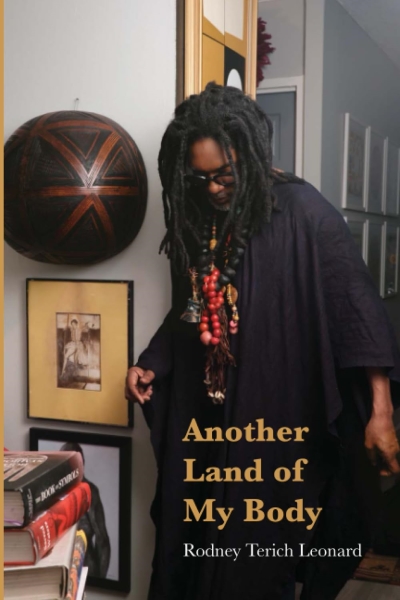
To live in Alabama is to live with death as a next-door neighbor. Among the states, only West Virginia and Mississippi rank below Alabama in life expectancy, and only Arkansas and Mississippi have higher infant mortality rates. The statistics for Alabama relating to standards like poverty and healthcare are similarly bleak. These dire realities leave many of Alabama’s citizens with a set of choices: accept Alabama as a doomed place, escape Alabama and leave all connections to the state behind, or find a way to live and thrive in the face of all the horrors and history connected to the state.
In Rodney Terich Leonard’s poetry collection Another Land of My Body, he gives readers an array of bodies that are in different relationships with the land and with death. For example, in “Nary a Thimble for Young Sadness,” Leonard’s speaker laments the death of Nigel Shelby, a Black teen in Huntsville who committed suicide due to the abuse he received for being openly gay. The first line of the poem— “Huntsville. Gay & out & bullied” shows Leonard’s talent for giving his readers an immediate setting and atmosphere in his poems. This poem wants readers to see Shelby as a connection to the histories of violence in Alabama and the United States, but it also wants readers to see that Shelby was never alone and is never alone. The speaker of the poem creates a kinship with Shelby when he says, “Born under the same moon, counties & storms apart / This scar above my ribs, the geography of people / yanking me for being me.” The speaker could have been Nigel Shelby. The poem connects Shelby to the speaker of the poem, but also to boys like Emmett Till and Tamir Rice, who were never allowed to have a full childhood due to the violence America is often ready to level against Black boys.
Death comes in other forms throughout Another Land of My Body. There is the threat of death due to racial violence and homophobic violence, but many poems focus on the threat of death that came with the onset of the COVID-19 pandemic. In “One Wall Away a Woman Dies of COVID-19,” Leonard puts readers in the middle of the dread and doom of the pandemic when the poem gives us a voice repeating “Uncle Nestor Uncle Nestor Uncle Nestor Uncle / Nestor Uncle Nestor Uncle Nestor Uncle Nestor” for the first 34 lines of the poem. The poem doesn’t say if the woman is calling for Uncle Nestor to join her in the world of the living or the world of the dead, but the constant calling out serves as a haunting reminder of the separation caused by the pandemic. The specter of COVID-19 appears again in poems like “Ms. Clematine & Ms. Bessie Will of Rockford & Alexander City, Alabama.” The poem gives readers a narrative of how the two women struggle and eventually succumb to the virus. From the early parts of the poem, when “COVID pumped up on these sisters / With their pre-Parkinson’s / & hypertension” to the end of their lives when “Clematine trucked to Flowers Hospital in Dothan. / Bessie Will refused Mobile. / Bessie Will went home & gasped.” However, the strongest lines of the poem are its opening ones: “Quick sad corridor care without Kleenex & wipes. / They paid taxes in an American town with six ICU beds.” These lines show that Clematine and Bessie, like many other people in Alabama and nationwide, were in dire situations before the pandemic. If COVID-19 didn’t end them, they still faced a healthcare system that had left them behind. The mention of taxes in those opening lines also points to a supposed agreement between citizens and a government, but the poem shows how governments often don’t live up to those agreements.
Faced with the longstanding traditions of racial and sexual violence and the new horrors of COVID-19, a weaker collection might present the reader with a speaker only filled with rage or despair. However, Leonard shows readers a speaker who refuses to succumb to the dangers around him. The title poem, “Another Land of My Body,” starts with the following:
An abrupt ravine.
I learned another land of my body.
Packaged trauma—
Eleven orchids refusing mist.
Maimed to the bone.
There’s violence in the opening of the poem— “Packaged trauma,” “Maimed to the bone”—but the poem moves to show how want and desire can exist despite the violence. The poem ends with the following:
He rocked a red cap backwards.
My pinkie strolled across corduroy.
Grown shame is shame groomed.
Here I can’t say what I sometimes crave.
Hunger is one of my songs.
The poem closes with music, and, of course, music can be either a celebration or a memorial. Music can hold joy or pain. The hunger at the end of the poem receives no modifier, so readers can take this hunger as an all-encompassing hunger that will not be quenched or silenced by traumas or societal threats. This ending also brings to mind Frederick Douglass’s statements on Black music in his autobiography. Douglass recounts how he has heard people compliment the pleasant sounds of enslaved Black people singing. Douglass says this is a misconception. He states that the music of enslaved Black people is a music of hurt and sadness, but it takes an understanding of enslaved Black people to truly understand the music. In this poem, part of the hunger seems not just to be a hunger for another body, but a hunger for a land where the songs out of the speaker’s mouth can find ears that understand.
This want for connection ultimately leads readers out of the collection. “What’s New at 50?,” the final poem of the collection, features a speaker contemplating mortality and possibility. The poem ends with this:
Alone, nothing aches. This year
In the dream the woman I’ve seen
Since 12 has one leg & a new porch.
I want a mate who can write my Obituary.
I’m at my retrospective.
Let me call you back.
The final poem gives readers two possible paths forward for the poem’s speaker. There’s the choice of loneliness, a solitary life where “nothing aches,” and there’s the choice of a life with “a mate who can write my Obituary.” These paths lead to a different life and a different death. A painless and lonely life or a life of desire and searching filled with the perils that desire and searching can bring. However, the pressure of this choice is diffused by the last line of “Let me call you back.” The speaker is not in a hurry to choose one lane or the other. In the end, even with the pressures of aging and death pressing from every corner of the collection, the speaker chooses to move on his own schedule. When he’s ready to choose his next stage in life, he will let the world know. He will call back on his own terms.
Another Land of My Body reminds me of what it’s like to travel the world and carry the history of Alabama with me. But the collection also reminds me of some of my favorite epic poems. In Beowulf, the titular hero descends into the hellish swamp to confront Grendel’s mother. In Homer’s Odyssey, Odysseus travels to Hades and must listen to the pain of his dead friends in his quest to gain the information he needs to finally return home to Ithaca. In Another Land of My Body, Leonard’s speaker takes readers on a journey through a type of underworld filled with broken promises and broken bodies. However, like the heroes in many of the old epics, Leonard’s speaker climbs out of the underworld with a new knowledge of how to appreciate his body and new tools to help him survive. And through reading Another Land of My Body, readers can find new ways to define their own relationships with their bodies and homelands, along with finding new paths for their own survival.
Jason McCall holds an MFA from the University of Miami. His recent collections include the essay collection Razed by TV Sets and the poetry collections Two-Face God, A Man Ain’t Nothin’, and What Shot Did You Ever Take (co-authored with Brian Oliu). He is a native of Montgomery, Alabama, and he currently teaches at the University of North Alabama.

Leave A Comment
You must be logged in to post a comment.