
Work Lunch
By Lee Bains
Hub City Press; 2026
Paperback: $18.00
Genre: Poetry
Reviewed by Edward Journey
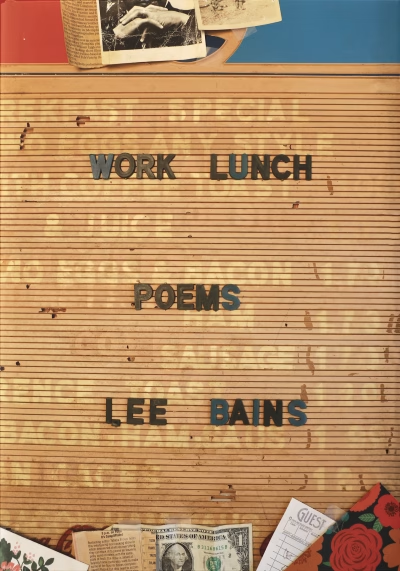
Lee Bains’s expansive poetry has been compared to Whitman and Sandburg. Those comparisons ring true in the range of Bains’s language and skill at pulling a multitude of rivulets and impressions together to make a complex world more precise and inspiring. By the time I got to “Salad,” the final poem in Work Lunch, Bains’s authentic and essential poetry collection, I couldn’t escape a comparison to another American poet, Allan Ginsberg, and the feeling that Bains, in an epic of the Southern working class, has written his own “Howl.” His poetry is mesmeric like that.
Lee Bains is best-known as the frontman for the edgy rock band Lee Bains and the Glory Fires (he was in the Dexateens before that). There’s a Bomb in Gilead, his first album with the Glory Fires, first attracted my attention for the title alone. The album itself was well worth the listen. Moving forward, the band’s hard-driving sound and Bains’s provocative lyrics continue through albums like Dereconstructed, Youth Detention, and Old Time Folks. The music, which Rolling Stone labeled “Southern Gospel Punk,” has the pulse of the South with lyrics that defy Southern stereotypes.
Bains hails from the “blue-collar suave and steel-city shine of East Birmingham” and currently lives and works in “the great shipwreck of Atlanta.” When he’s not touring with the band, he is an erstwhile handyman. The poems of Work Lunch (several of which were previously published under the same title with a 2021 photo essay in the New Yorker) are long-form free verse and as defiant as the song lyrics. Bains uses Southern foodways as a launching pad for freewheeling poems about capitalism, workers’ rights, family, immigration, inequity, class and culture, history, religion, hypocrisy, and an ominous future. These are also poems of memory, pride, resilience, and hope. Bains’s poems aren’t angry or “woke,” just honest.
In “Barbeque Spots,” Bains describes himself and a couple of friends as “shit-headed cracker boys” with “Too much education / too little work / too much time / too little cash.” Despite his rock musician cred, Bains identifies most with his working class bona fides, earned through his family, his place, and his inspirations. Along with that, he has a degree in English from NYU. “College was not an option for me … / it was a requirement,” he writes in “Biscuit.”
To read these poems is to get to know Bains’s people, especially his mail carrier Granddaddy and his grandmother, “my Mimi.” Mimi runs the kindergarten and the church choir. A woman of her time is liberated to work outside the house “so long as it was done outside the hours / of her cooking / and cleaning / and washing / and babying.” His Granddaddy does his part around the house, too, having learned “as a boy / that a man / had to help, or else he wasn’t a man at all.” His Granddaddy knew how to “work words,” like he worked his hand-built shelves or toolboxes or his smoker. Bains relishes the implications of the word “influent,” his grandfather’s coinage. When he carelessly dismisses workers on a truck bed as “white trash,” his grandfather’s response, “Son, you aren’t any better than anybody else,” elicits the poet’s breathless respect and a word-by-word breakdown and explication of that sentence’s noble and deliberate construction.
To read these poems is to be regaled with tastes, to savor pulled pork that has “the texture of the ropy sawdust that unspools when a dull blade / chews up a rained-on board.” It is to learn more than you ever dreamed there was to know about the Greek-owned hot dog stands in Birmingham, and that Grandmama – even when given the chance to go “to the Bright Star / or the Red Lobster, she’d usually just / rather a good hot dog and some potato chips.” It is to learn how Birmingham’s early Greek immigrants managed to “transform wieners on whitebread into a cornerstone / of a blue-collar city’s unlikely culinary cathedral.” It is to remind us of the diversity of the hot dog stand clientele and to remind us that the word “Mediterranean” translates to “Middle of the Earth.”
“National Fast Food Entity 1” contemplates the humanity gathered for the increasingly costlier offerings while “National Fast Food Entity 2” expresses solidarity with the workers on strike for a living wage (“We are worth more”). Individual foodways become a totem of social status in these poems and tangents often expand to fulfill momentum. In the poem “Vietnamese Place,” banh mi served at “a white man’s meeting. / At a Vietnamese restaurant” leads to thoughts of a po boy which leads to thoughts of “poor boys working the steaming tropical docks.” Across the street from Al’s, a Mediterranean deli and grill, the former parking lot of the New Women All Woman clinic evokes the bombing that destroyed it and the perpetrator who detonated it. The “pinching” and “pulling” of a boy’s motion while helping his grandmother make cornbread dressing becomes the “pinch, pull” refrain for “Salad” – a poem that travels through time and U.S. presidential administrations and lands at Sears-Roebuck houses, Joe Minter’s “African Village” installation in Birmingham, the “great grassy mounds” built by Natives on the Black Warrior River, the post office where his grandfather didn’t take a sick day for thirty-six years, the “sanctified Gulf of Mexico.”
Bains considers “the quandary of global consumer capitalism” while “trying to make cuts on a winter tomato / of unknown origin” and blasts Milton Friedman’s callous stance on the economics of illegal immigration. He ponders the economic and environmental waste of our “sky-scraping end of time.” To comments about jobs no American citizen “wants” or “will do,” the poet’s eye-rolling response is “A job, by definition / … is a thing / you don’t want to do.” He examines his World War II veteran grandfather’s muted but kind reaction to meeting his grandson’s Asian girlfriend.
The poems of Work Lunch have clout, verbal grit, and frequent majesty. They are topical and urgent, good-natured and ironic. “You can build a self, maybe,” Bains writes, “but you can’t build a soul.” In Work Lunch, Bains’s soulful poems have a primordial heft.
Edward Journey, a retired university professor and theatre professional living in Birmingham, regularly shares his essays in the online journal “Professional Southerner” (www.professionalsoutherner.com).




Leave A Comment
You must be logged in to post a comment.