
Ballantine Books, 2025
Hardcover: $30.00
Genre: Historical Fiction /Coming of Age/Magical Realism
Reviewed by Dr. Candice N. Hale
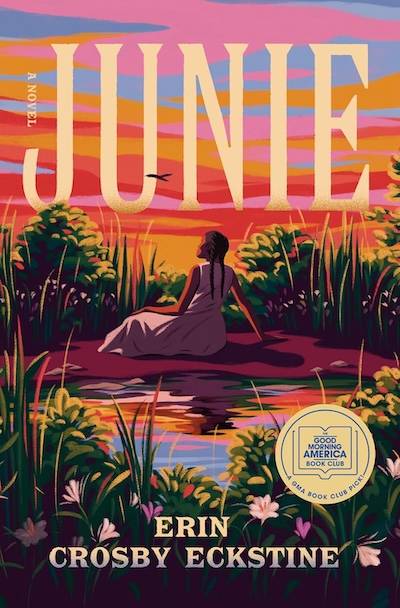
As William Faulkner reminds us, “The past is never dead. It’s not even past.” His enduring truth reverberates throughout Erin Crosby Eckstine’s powerful debut novel, Junie, urging readers to open themselves up to both unlearning and understanding. From Eckstine’s compelling storytelling, we learn how sixteen-year-old Junie navigates trauma, grief, and loss during her enslavement in pre-Civil War Alabama. Let me be clear, Junie is more than a story of suffering—this novel demonstrates the strength and resilience of a young Black girl who defies and resists the peculiar institution. Eckstine’s courageous protagonist dares to love, fights for freedom, and believes in self-expression in a world seeking to silence and control her.
As Junie comes of age on the Bellerine Plantation, she exposes the harsh realities of enslavement. Yet, Junie demands more for her life, rewriting spaces for Black girls that defy and resist. In fact, she refuses to follow rules or remain complacent with slavery’s oppressive whip. What we gain from Junie’s characterization is a bold, daring Black girl who forces herself outside the margins of social degradation, denied humanity, and dehumanization.
Junie is an exemplary character not because she moves in secret and silence across the plantation, but because she is vulnerable, bold, and dares to pursue a life greater than one defined by inferiority and marginalization. Junie’s escapades through the Southern landscape tell readers, “Maybe that is why she ventures to places she isn’t meant to go. To chase after the ember that promises a forest fire” (8). Junie frolics with danger and risk, not out of recklessness, but as an act of defiance—a pursuit of something greater than what the world has offered her. A mother’s wisdom is near, though, and she guides Junie through her choices: “Junie, there ain’t nothing you can do about anybody else’s choices. The only thing you can do is take control of your own. It’s what Momma wanted for us” (189). As a Black woman from Alabama, I stand with Junie, understanding her passion and dogged determination to survive and live boldly. Her sister Minnie exclaims: “You ain’t foolish, Delilah June. You just got a heart too big for this world. White folks do crazy things, even the ones you think got a head on their shoulders. The power spoils ’em all (255).” Junie’s determination to survive against all odds pushes the goals towards transformation and reclamation of power. “It’s what we can choose that makes this life special (255),” one elder tells her, underscoring the central theme of agency.
As a native Alabamian, eldest daughter, educator, and mother, I read Junie with a special reverence and optimism about the importance of storytelling and testimony. Suppose readers miss the importance of ancestral knowledge and truth-telling from the elders carrying Junie metaphorically through to the other side of joy and power. In that case, they miss the beauty of love as a radical act and how magical elements can help to transcend trauma and pain. Eckstine’s blend of historical fiction and magical realism is not only alluring—it is necessary. Magical realism reminds readers that ancestral memories, buried secrets, and ghosts left behind on corrupt land are not only prescient but also still exist in the soil, the rivers, and the land of Alabama. Those memories contain pain, resistance, and defiance, and Junie finds a path mirroring her ancestors’ own fights against oppression. Junie’s story is not irrelevant. It mimics the world we live in now, especially for Black people of Alabama who still must confront systemic and structural barriers, deep-seated trauma, and struggles for freedom.
Her journey reminded me of the many ways Black women in the South have always carved out space for love and life in the margins—“even if you have to squeeze in to find it” (241). It reflects the quiet rebellions of our mothers and grandmothers, the weight of inherited silence, and the beauty we fight to hold in our hands.
When Caleb demands from Junie, “You deserve to bite it like a peach and let the juice drip ’til your fingers get sticky” (351), I felt his words stir a deep call-to-action to love boldly and defiantly. Characters are praying for Junie’s joyful transformation while she works hard to manifest it. Junie is well aware that her “peculiar condition” should be devoid of any joy, but her ancestors propel her forward into a river of hope and self-love.
This novel doesn’t offer easy answers, but it does offer truth. And in a world that often demands our silence, Junie insists that our stories matter. That our pain is real. That our love is revolutionary. That our voices—Southern, Black, and female—are the embers that can still spark a forest fire.
Candice is a part-time book influencer on IG, freelance writer and reviewer, and professor of composition and literature at Auburn University. In August 2023, she contributed to the edited collection Jesmyn Ward: New Critical Essays by Edinburgh University Press.

Leave A Comment
You must be logged in to post a comment.