
Long Eye: Poems
By Kwoya Fagin Maples
Hub City Press, 2026
Paper: 16.95
Genre: poetry, eco-poetry
Reviewed by Laura Secord
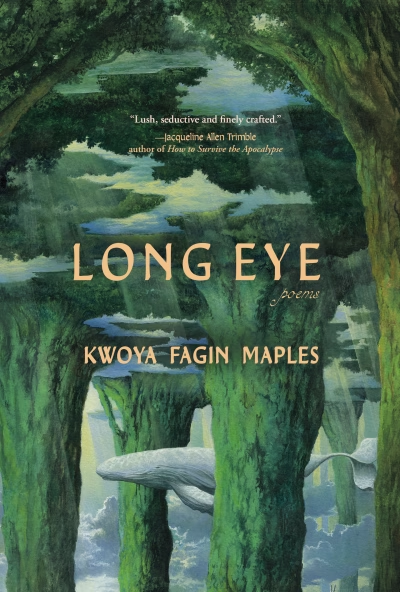 Long Eye by Kwoya Fagin Maples is a lyrical tapestry woven with seas, currents, ocean creatures, whales, lost ancestors, marriage, motherhood, family love, and a Black Mermaid.
The Black Mermaid speaks the Prelude. She is based on the West African deity Mami Wata (or water mother), who is believed to have rescued the kidnapped Africans who were thrown or driven from ships during the Middle Passage. She takes us into her ocean world in the recurrent Autobiography of a Black Mermaid poem series:
“Every body of water ripples in wind.
The sunball —tossed like salt onto waves—
sinks in beams that sound
beneath, clear to the living beds of varied corals
whose chalices and tentacles drift in tide
Every morning the reef hosts its chorus:
in arrangements of clicks, burbles and whistles,
parrot fish crunching coral to excrete sand,
damselfish claiming thickets,
while dolphins choreograph alluring displays
Every underwater being exists in relation:
eels and trout pair to hunt, the anemone
glamours to aid clown fish tucked in its flutter
and after its meal of sunlight, the reef
feels its own glaze of algae
Every animal being in concert
and I, why was I given this Atlantic body?
I bend the current,
refusing name or tether, seeking
to be and move how I choose.”
The reader encounters the mermaid’s voice at the start of each segment of the book, while within, the poet shares her own Atlantic body. Ultimately, the desire “to be and move how I chose” is central to the heart of this beautiful volume.
Kwoya Fagin Maples became a renowned master of the persona poem with her first book, Mend. Now, in Long Eye, she’s found a way to let the reader know her personal persona as she journeys through childhood, love, motherhood, and blackness. It’s all held together by the Black Mermaid’s story and the vast beauty of the Atlantic Sea. The first poems of the collection introduce characters and themes essential to our coming journey:
~ The Blue Whale, from Blue Whale Chimera— “… Moved/beyond human griefs/… sustained/by an impossible love/ at great depths beneath the sea…// her heart/the size of a Volkswagen”;
~The ocean: “I lie on the surface and swim/for the first time since my lessons/… minutes in my limbs accept/… I wrap my arms around the sea” (When We Get To The Ocean, I Don’t See It), where she surrenders to her beloved Atlantic as her daughters collect “surf and sparks’ along the shore;
~Beauty “…Unable to keep up with my body,/now lifted off to wonder…/so much is stunning me at once…./ (Attention Deficit Pastoral); and
~ Blackness— As “the man (she) loves and (her) sunlit girls skitter” on her beloved shore, she feels tinged with the
“sense of foreboding I sit with in predominantly white spaces
how this strained heart pushes past my sternum
to wrap the bright bodies of loved ones, pull them in.”
(The Beach is Host to Small Things).
These become signposts on Long Eye’s underwater journeys— the poet’s journey through childhood and family sits side-by-side with the Black Mermaid’s journey. As the mermaid builds an underwater home for “the burnished skins, seal-slick” folks who’ve jumped ships and follow her guidance,
“bewilder-struck
or wonder-cast for what now expands the ribcage;
the school of winding fish that now swims the sightline,
And they are all so long-eyed with wanting/
It urges me. How to convince them?
There is mercy in water, relief,
for evil on land…”
The poet addresses the Black Mermaid’s meaning of “evil on the land.” And what are the “long-eyed wantings” of the landlocked? Maples is a native of Charleston’s Atlantic coast. In “Atlantic Origin,” she states:
“I gullah geechee people,
open crab with my hands and teeth/
…My people are salt. Stayed on
lots receding from the Atlantic
as if by magic…”
Yet the poet has raised her family away from the sea, where on its shorelines she’s encountered traumas, rescuing her
“small brother from ”… a tourist,
a white man pointing towards his hotel—
all for a promised shark tooth. I yelled for him,
…Folly Beach. He was six. /He almost went.” (Folly Beach);
and her effort to save her childhood home from anger, in Passover for a Marriage, she “smudges olive oil to wooden entryways, / … the way the Israelites warded off/ their own angels of disaster,” but burns the beans, directing familial anger towards herself.
She arranges these stories as she begins her own marriage, telling her new husband,
“When you asked me to marry you,
you asked me to forget what I knew,
What I’d seen of love—a home
on the back burner till it charred.
A mercurial affection, an itching to fight”.
In light of it all,
you were still gearing up to ask.
I decided to marry you,
and asked you to forget
your escapes to the woods on days
harder than my own.
I determined I would teach you
I determined,
we would learn together,
and so on our honeymoon
when the bee stung your ankle and you screamed,
I felt its poison shooting into my veins! I confess.
It was me infecting you with all the hope I could muster.”
She lets us in on the marital eroticism of baby-making:
“…whatever corner could be caught drunk
in pleasure tiptoe naked see my forehead
sometimes thud against the mirror
face left on the glass glance of the red
flush over my breasts) deep down/ in hidden memory” (The Plan).
Later, peering at her newborn twins, she imagines a hungry owl and the “reluctant lion” father who smacks the owl away (Sleep Deprived in the Waiting Room); and lets us see the “glow-/in-the-dark/ pacifier dangle at his lips, muddling (his) seduction/…Me, engorged with laughter.” (Love, Postpartum).
Remarkably, the poet knots these land-locked and ocean worlds together when the Black Mermaid “soothes” the Blue Whale’s labor (p.42), and the poet muses with Three Heads of Hair to Comb, “it’s all in the parting…//I want my daughters to be wholly loved/They will be covered. Their heads are covered/ with their mother’s intention.”
Within her intuitive weaving, the poet joins the Black Mermaid as the Blue Whale speaks to both mermaid and poet:
“You are half-earth & I am the sea you know
We both linger at what we perceive
not understanding:
…you are intent:
on claiming what could never be for long,
and striving to to push off what’s been purposed:”
and a Black Mermaid answers as if speaking for the poet too:
“Having only traveled oversea my people are oblivious
to underwater terrain, how it reflects land:
in sea mounts, canyons, plateaus
They’ve never known the ocean is broader
than what they’ve seen of horizon
Though some recall betrayal, they’d return
as quickly as they sailed across
We trust you mami wata, to take us home,
What is home? I ask
as their lie grows dense, eyes wide
to sightlessness
An ocean tapestry, Long Eye breathes underwater, moves through currents of labor and grief. Like the mermaid, the poet leads readers across the seabed, building worlds below and above the waves.
Laura Secord is a poet, storyteller, teaching artist. Her novel-in-poems, An Art, A Craft, A Mystery was awarded the 2024 Authors Award for Poetry by the Alabama Library Association and was chosen as the best Indie Historical Fiction of 2022 by Kirkus Reviews. A Pushcart nominee, her poems appear in Poetry, NELLE, the Anthology, What Things Cost, Hobo Camp Review, Shift, Simple Machines, Cahoodleloodling, Finishing Line Press, Burning House Press, and more. She’s worked as a printer, union organizer, health care activist, teacher, sex-educator and nurse practitioner in community health and HIV care. She served as Director of Community Engagement for The Magic City Poetry Festival.

Leave A Comment
You must be logged in to post a comment.