
The Passions of Saint Francis
By Charles Gaines
The Crossroad Publishing Company; 2026
Paperback: $29.95
Genre: Historical Fiction
Reviewed by Edward Journey
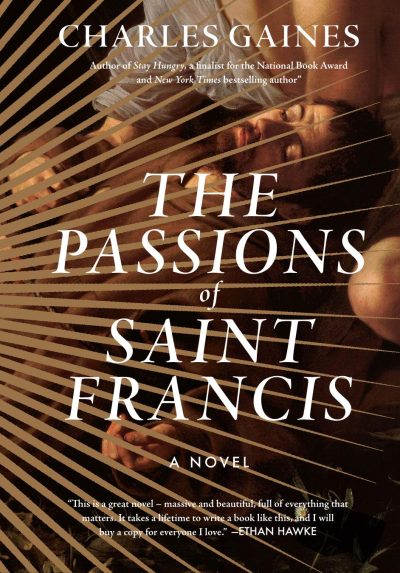
In The Passions of Saint Francis, the inspiring new novel by Charles Gaines, the writer ponders the big questions of life and the hereafter as he presents the life of Giovanni di Pietro di Bernardone (1181-1226), born into privileged nobility, nicknamed Francesco by his father, and living a profligate life until he chooses to live a monastic life, become a friar, and found the Franciscan order. The story of Saint Francis of Assisi is paired with the story of Chiara Offreducio (1194-1253), also of noble birth, who becomes an acolyte of Francesco and the co-founder, with Francesco, of the Order of Poor Ladies, now known as the Poor Clares, in honor of its founder, Chiara – remembered now as Saint Clare of Assisi.
Gaines structures The Passions of Saint Francis as a series of journal entries written by Brother Leo, a devoted member of the Franciscan order who accompanies Francesco throughout his ministry and is with him until he dies; Cecilia, a conflicted novitiate of the Order of Poor Ladies, is chosen by Mother Chiara to take down her memories before she dies, twenty-seven years after Saint Francis. Leo and Cecilia come together after Chiara’s death to combine their two sets of manuscripts to give a more complete chronicle of the life of Francis and Chiara together and separately – their lives of poverty, their ministries, and their repressed earthly passion for each other. At the beginning of her dictation to Cecilia, Chiara says, “I hope you are not easily shocked.” Indeed, when the Catholic Church learns of the manuscripts’ existence, it attempts to seize and destroy them since the truth of Francis’s life and rebellious ministry may be too much for Rome. Through clever trickery, Cecilia manages to save the manuscripts which present these revered holy icons as transcendent, but also human and flawed.
By presenting two intersecting lives through the conceit of two intersecting narratives, Gaines creates an opportunity to ponder the complexities of his primary characters through the lens of two additional complementary characters who have their own conflicts, complexities, and points of view with which to grapple. The introduction into the narrative of Urso, Leo’s “uncerebral, clamorously atheistic brother,” offers a strong counterpoint within the narrative. Gaines develops these characters as distinct individuals and their discussions, arguments, and philosophical ponderings provide an intricacy and substance that might be lost in a more straightforward biography. Especially enjoyable is the unlikely and affectionate bond that forms between Francesco and Urso as Urso protects his brother and Francesco during Francesco’s particularly bleak period of doubt, anxiety, and self-exile at La Verna on a secluded mountaintop. And it is on that mountaintop that Francesco’s “wounds of Christ,” the stigmata, first appear.
The Passions of Saint Francis is a grand and sprawling tale and a heady book, full of miracles, adventures, visions, nightmares, synchronized dreams, and mysticism as well as doubts, triumphs, war, and the far-ranging beliefs and contradictions intrinsic to Christian faith. Leo, who asserts that the only talents he owns are “loyalty and love,” is convinced that his penance for a past sin is to “mold a saint.” With that knowledge, Leo’s steadfast devotion to Francesco and to being a witness to Francesco’s commitment and miracles is an inspiration in itself. In intense verbal sparring matches pitting Leo’s faithful spirituality against Urso’s skeptical carnality, Leo debates his brother about the existence and logic of a merciful God in a world of suffering. As Leo argues that personal freedom can only be obtained through selflessness and forgiveness, Urso accuses his pious brother of only living “for death.”
After Chiara’s warning to Cecilia about being easily shocked, Cecilia realizes that the story Chiara reveals about her early life is “enough to shock a monastery full of oxen.” In it, Chiara speaks of the physical attraction shared by her and Francesco and of the pain she suffers when he sends her away because of the temptation she represents. “In the crucible of that absence” however, Chiara finds that God has rendered the pair “joined though separate, like the white and yolk of an egg enshelled by Christ … to be for each other both the Light and the Light beheld, the ache and the ache healed.”
Such elevated spirituality and florid prose are found throughout The Passions of Saint Francis, but Gaines, always a gifted storyteller and master of characterization, presents lengthy passages of theological debate whilc also creating an engaging page-turner. As he alternates the journal entries of Leo and Cecilia, he teases the reader with hints of answers to come; he includes cliffhangers – sometimes even literal ones. Intrigue and humor, villains and heroes, temptresses and dupes all become a part of this story of the molding and triumph of two human beings who sacrifice human passion for a passion for service and a destiny of sainthood. It is also a story of the people who fall under their spell. Even the creatures of the natural world recognize Francesco as kindred. Gaines includes those moments, too.
In 1219, Francesco, accompanied by Leo, travels to the Holy Land where both are horrified and disillusioned by the savagery of the European forces in the Fifth Crusade, a lamentable example of murderous Christian Imperialism made even worse by the fact that it is done in the name of God. Francesco and Leo risk death by crossing enemy lines to meet with and witness to the powerful sultan, Malik Al-Kamil, and try to forge a peace. Francesco’s attempts at conversion are fruitless, but his sessions with the sultan are among the most satisfying philosophical discussions in this compelling and challenging book. Gaines also is tactfully calling to mind the thinly disguised theological conflicts of our contemporary world.
Three of the principle characters of The Passions of Saint Francis are facing their impending death. It is hard to ignore the fact that Charles Gaines, who died less than three months before the book’s publication, was also aware of his own imminent death by the time this, his decade-long passion project, was being edited. Gaines, inducted into the Alabama Writers Hall of Fame in 2018, was a prolific writer of novels, nonfiction, scripts, essays, and memoirs about sports, bodybuilding, the outdoors. He was an adventurer, always seeking the next thrill and the opportunity to share it with readers in his engaging, personal, and luminous prose. His life seemed to be a perpetual quest. His first novel, Stay Hungry – still the best novel set in Birmingham, is about a wealthy Mountain Brook boy seeking adventure and discovering himself in the process with a mentor named Joe Santo (Saint Joe?). Gaines’s final book, written half a century later, is still searching – rooted in the spiritual as it asks the big, debatable, and unanswerable questions about what it means to be human, what makes a life well-lived, and what happens when it’s over. Near the end of The Passions of Saint Francis, Charles Gaines writes, in the voice of Brother Leo, a statement that sums up the quests of his final book and, indeed, summarizes his lifelong quests as a writer and as a man. Gaines writes:
“It seems to me we pass through life rather like a child passing through a room in which a very wise man is speaking all the truths there ever were. The child has not heard the beginning of the speech and will be gone from the room long before its end.”
Edward Journey, a retired university professor and theatre professional living in Birmingham, regularly shares his essays in the online journal “Professional Southerner.”


Leave A Comment
You must be logged in to post a comment.