
Fourteenth Colony: The Forgotten Story of the Gulf South During America’s Revolutionary Era
By Mike Bunn
NewSouth Books, 2026
Paperback: $28.95
Genre: History/Colonial
Reviewed by Foster Dickson
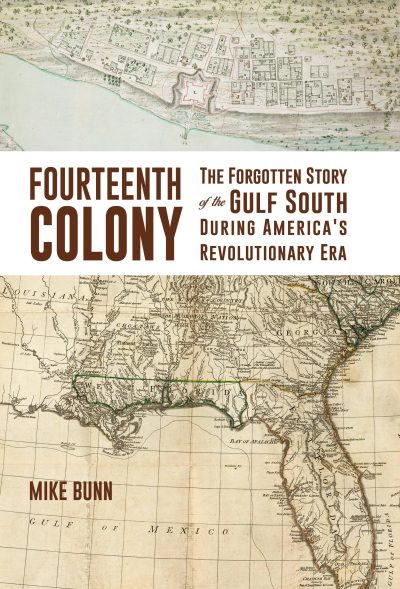
Who ever heard of an American colony called West Florida? Certainly not me, until I read historian Mike Bunn’s book Fourteenth Colony. There is a good reason that the subtitle begins with “The Forgotten Story of…” We Americans have been taught for generations that there were thirteen colonies—Maine to Georgia. Yet, like so many aspects of our common history, closer examination yields different truths, which can be more holistic, more contextual, and more exacting.
This story begins an English military victory in the French and Indian War, which shifted the balance of power in the area of the Gulf Coast in the 1760s. To start us off, Bunn explains how French and Spanish colonizers had led the way in the New World, establishing the now-familiar port cities of New Orleans, Mobile, and Pensacola. Yet, neither the cities nor the surrounding territories were well-developed, so the British had a lot of work to do when they claimed dominion, especially considering that many of the previous colonists left rather than submit to British authority. Another challenge was the balance of power with the indigenous people, who had grown accustomed to the working with the French, had been warned not to trust the British, and who also debated and quarreled among themselves. There were mighty challenges in front of the new authorities, like fortifying military outposts, establishing governmental systems, bringing in settlers, managing and taxing trade, and growing a viable source of exports, that last one being the reason for doing the first four. Here, we have the colony of West Florida, which encompassed territory in the modern areas of southern Mississippi, southern Alabama, and northern Florida, courtesy of King George III.
After those initial chapters, Bunn’s next three give the reader a sense of how things went for the colonists of West Florida: “Settlement,” “Daily Life,” and “Earning a Living.” This portion of the book weaves in exposition with narrative, relaying facts alongside events and names. We learn that the possibilities for agriculture in the more established coastal areas were slimmer than hoped for, and that those who traveled further inland to build a homestead essentially did so at their own peril. Of course, many of these settlers were from the British Isles, whose climate is nothing like the Gulf Coast. The heat and the insects were unanticipated daily challenges over and above eking out a living, all while trying to maintain safety and order.
By chapter seven, the American Revolution is becoming a real possibility. Bunn opens that chapter by referring to “West Florida’s weak and infrequently meeting legislative body,” which we read about in the early chapters, then he mentions how the “population could be described more accurately as self-interested than overtly loyal” to the British crown. The climate, both meteorological and political, was unlike that of the colonies along the Mid-Atlantic Coast, where that fervor for revolution was fomented. Our forebears on the Gulf had concerns that were closer to home.
The book’s latter chapters help us to understand that the colony was not without incident, though, as the Revolutionary War went on. Chapter eight apprises us of Willing’s Raid, a haphazard and ragtag effort at – supposedly – hitting the British where they did not expect it, which may have actually been one embittered man’s ruse for attacking his personal enemies in places where he once lived. Yet, the raid incited events that were important beyond the raid itself, and chapter nine dives into the history that we would recognize. After Willing’s Raid, the British had to acknowledge a weakness in their defenses if an effort so sloppy could yield any results. This led the Brits and their local authorities to greater attentiveness on West Florida; fortifications were re-evaluated, and a General Assembly was called. As the war continued, the French got involved, then the Spanish, and it was on! This southernmost colony was no longer irrelevant, nor indifferent. The final chapters also introduce readers to a man few of us have heard of, Bernardo de Galvez, a Spaniard whose successful military campaigns in the Gulf led to “the capture of Mobile” and, ultimately, the shift to Spanish power in Florida in the early 1780s.
Reading Fourteenth Colony, I found myself alternating between two sentiments: “I didn’t know that,” and “I remember learning that.” For those of us who live in the Deep South, the French roots or Spanish roots of various towns and cities are easily recognized, even if only in the names. Here, we read not only about Mobile, Alabama and Pensacola, Florida, but also Natchez, Mississippi and Fort Toulouse near Wetumpka, Alabama. Through a heavily researched text, Mike Bunn does a good job of weaving together the necessary facts with stories of the people and groups who intermingled – or sometimes refused to – as the region’s heterogeneous American roots took hold. And by the end, we realize that he really does have a point: it was never as simple as we many have been led to believe.
Foster Dickson is a writer, editor, and teacher in Montgomery, Alabama.




Leave A Comment
You must be logged in to post a comment.