
Edited by Sue Brannan Walker and Saundra Scribner Grace
Negative Capability Press, 2024
Paper: $18
Genre: Poetry
Reviewed by Jessica Jones
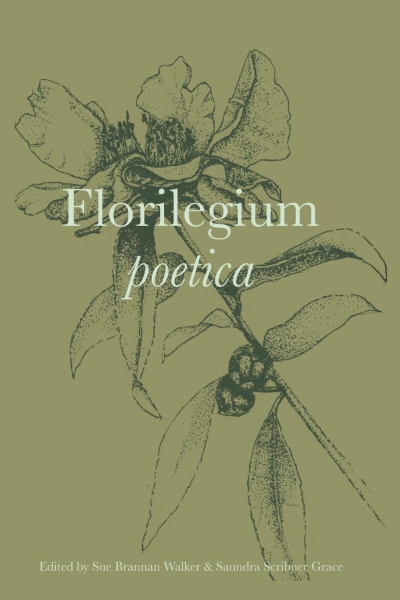 Florilegium poetica wanders through hedgerows, courtyards, and blossoms throughout Mobile Botanical Gardens. Poetry comes alive here—grows stronger with each poet’s nutrients, water, pruning, humming soft words of encouragement, lyrics, and rhyme. The pattern of pages weaves a tapestry of rich flora as notes of sweetness, sour, savory, and bitterness spill out to feed another reader, another writer, another naturalist.
The collection grew out of the Writers in Nature Poetry Group, a group of twenty-one writers who meet weekly at the gardens. Led by 2025 Alabama Writers Hall of Fame inductee Sue Brannan Walker and Saundra Scribner Grace, the group includes such writers as Gurupreet K. Khalsa, Linda Busby Parker, and Maryella Desak Sirmon. Their poems build upon each other through themes of friendship, place, nature, love, sorrow, family, comedy, and transcendence. They strengthen and challenge each other. They reveal more of their depths as they stand petal to petal, pollinating one another.
Moments of friendship develop in the first pages, evoking memories of withering relationships, loss, teaching, and beyond. The hibiscus foretells the temporal nature of human relations—we revel in the joy, then ponder the dissolution. Disillusioned. We remember permanence beyond death in the thoughtful description of a tree’s growth and seasons. We see a teacher whose tough love breaks down barriers and stops silence but also teaches us the harsh sting of reality. These poems about interpersonal relationships paint a picture of the beauty and pain found in life’s shared moments.
The section on place plants us firmly on scenic mountain tops, sandy beaches, and storied landscapes, where many travelers’ delicious experiences are found among the pages. One poem brings Kilimanjaro’s stunningly exotic landscape to life as we sit comfortably on the couch, reading glasses on our noses, book in hand. Another drops us in the middle of a dilapidated house, and a landscape strewn with memories. We see the value of good building, of strong character, and of faith and family. We celebrate the aha-moment of Wordsworth’s daffodils in the tulip fields of Holland, bursting with color and offering up indulgent words.
Other places invite us to play in a mirrored river, where we delight in an upside-down world like the characters of Lewis Carroll. We see aging as the next adventure, a slower pace that takes in every glorious, sensory detail. Birds feast on seafood and frolic in words, then follow the ancient and ingrained ritual of migration. We are mesmerized by the wonder of a bluff through a boy’s eyes. We see a daughter clinging to an idyllic natural world, and a mother’s soft love and lessons of this place, their home, in heartbeats of haibun. We are even entranced by a messy kitchen that concentrates more on precious moments together rather than the air of spotless spaces.
The book’s nature section is filled with glorious details that wind around our mind’s eye like soft tendrils. This sensory adventure breathes in the salty sea air, follows a flight of swallows throughout a stunning array of verbs, and portrays a garden—alive with harvest and flocked with fowl—through a steaming cup of tea. We feel every anxious moment as a good Samaritan rescues a trapped snake, the man and reptile dancing in uncertainty, treacherous time, and final release. We see loveliness in the world’s flaws. Nature, in its mud, endless sky, and birdsong, can cure mental illness, set the stage for a peace-filled forest night, and illuminate the pieces of our storied past.
The section on love presents us with many new metaphors throughout its exchange of the age-old emotion. We find a writer filling a handmade paper journal with thoughts to savor her love’s precious gift. We swell with the small moments where love is real and tangible, like a painting hanging in the kitchen. Love transforms. Love transcends time. Young love aches, swoons over sandwiches. Old love honors and remembers. We see these poets blend harmony and nuance seamlessly.
Sorrow’s section purges with grief. It searches for a lost mate, seeks comfort in black birds, stars, the rhythms of nature, shallow air, but finds none. It falls into a mass grave in Charleston. It learns to fish again. It seeks surrender. These poems yearn, like grief assuaging loss.
Family’s section finds a way to portray memories before dementia, crawling inside makeshift tents, holding up aging against ivory keys. Broadway engulfs. Praise penetrates. Blueberries feed. Bravery dances. Adopted children complete. Family buries beloved. Sees reality. Protects. Pricks. Grandmothers. Swings and creaks. These poems embrace life’s every angle in familiar and new ways.
Humor’s section uplifts and brings chuckles to paper, reimagines fairy tales, and gives compliments to the chef. Finally, the section on transcendence launches into infinity with out-of-this-world words. It drenches fantasy with reality and celebrates the story of scars. Symphony mixes into the landscape. Dreamers penetrate an eclipse. It shapes poet and writer. Meditates. Becomes. We become, too, as we read.
Florilegium poetica immerses us in a garden of poetry, stunning illustrations of flora, and celebrations of life, throughout its parched and plentiful phases. It invites readers to revel in changing seasons, in sensory experiences, and in new perspectives. It begs the reader, “Come to the garden, and drink.”
Jessica Jones graduated from the University of South Alabama with a Bachelor’s in English and Master’s in Creative Writing; she has received awards from National Federation of State Poetry Societies, Poets and Patrons Chicagoland, and Alabama State Poetry Society. She is the Alabama Writers’ Cooperative President. Her latest book of poetry, Naked Young Woman in Front of the Mirror was published by Negative Capability Press in December 2024.



Leave A Comment
You must be logged in to post a comment.